


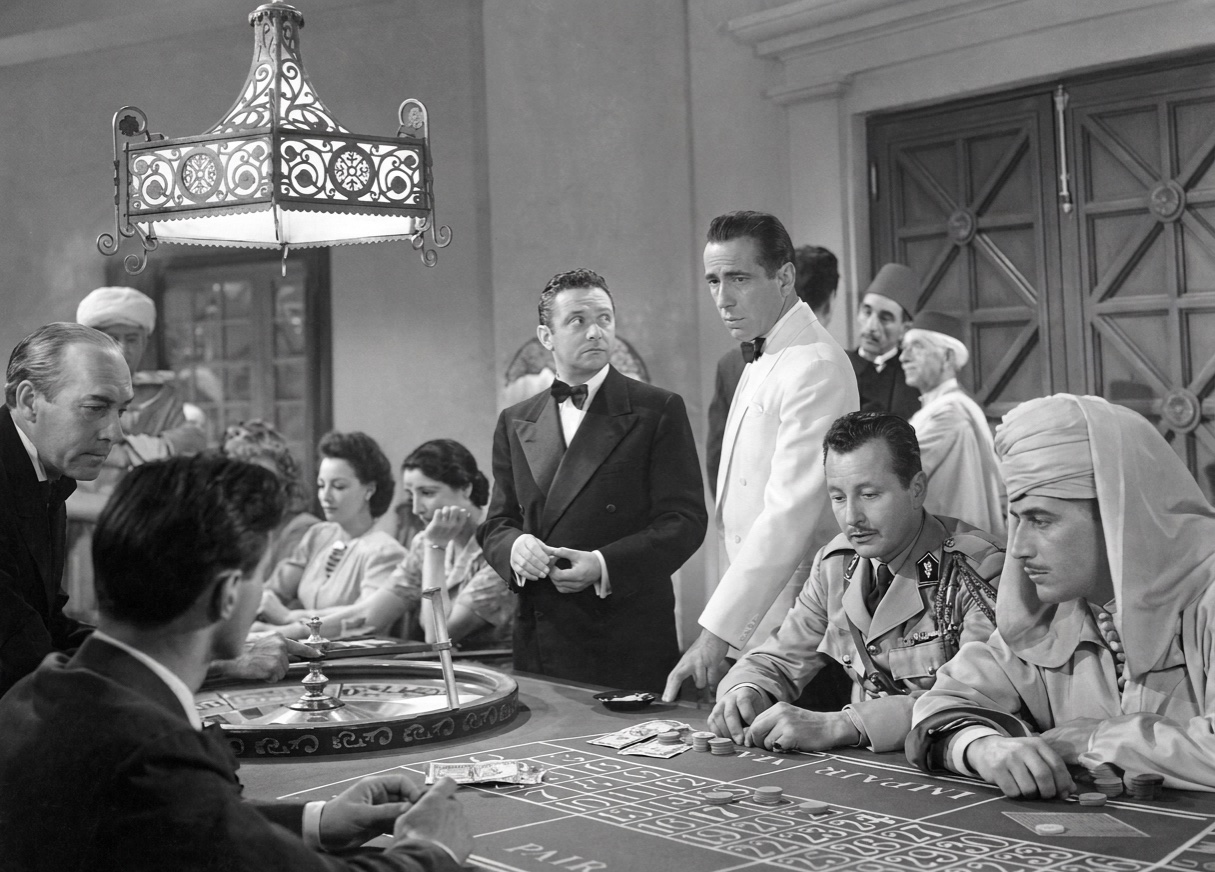
In Casablanca (1942), Rick Blaine strolls into the back room of his café, finds a young Bulgarian husband down to his last chips, and asks, “Have you tried 22 tonight?” The croupier, Emil, takes the hint, and the ball drops on 22 twice in a row. The gaming room was a Hollywood set, yet the scene stuck, because roulette arrives with a plot built in: a spin, a pause, a verdict. The machine behind that pause has a documented past that starts in France, a long way from Morocco.
Roulette means “little wheel” in French, and that is about the only part of its origin nobody disputes. A popular tale credits Blaise Pascal, who chased a perpetual-motion machine in the 17th century, but no numbered wheel from his time is documented. What survives is his 1654 correspondence with Pierre de Fermat, which helped lay the foundations of probability theory. The game more likely grew from a cross between English wheel games (Roly-Poly, Even-Odd) and Italian number lotteries (Biribi, Hoca). By 1758, an ordinance in New France (Québec) already banned dice, hoca, faro and roulette.
By the late 1790s, the ingredients had merged into the game still dealt today: a wheel, a ball, 36 numbers and pockets reserved for the bank. Anyone who wants to play roulette now meets one of two layouts. The European wheel has 37 pockets (one zero) and takes 2.70% on a standard bet, while the American wheel adds a double zero for 38 pockets and 5.26%. French rules such as la partage, which returns half of an even-money stake when the ball lands on zero, cut the edge to 1.35%. Betting closes when the croupier calls “rien ne va plus” (“nothing more goes” or “no more bets”).
The earliest detailed description comes from a French novel by Jacques Lablée, published in 180 and describing the Palais-Royal gaming rooms of Paris in 1796. Its wheel carried two slots for the bank, zero and double zero, from which the house drew its “sole mathematical advantage.” Those pockets were painted red and black, the same colors used for even-money bets, which invited confusion, so casinos switched the zeros to green in the 1800s.
Britannica places roulette’s emergence in the casinos of late-18th-century Europe, and the next change came from rivalry between them. In 1843 (some experts say 1842), the brothers François and Louis Blanc introduced a single-zero wheel at Bad Homburg, a German spa town, to lure players away from halls still using the double zero. François Blanc took over Monaco’s casino in 1863, and when Germany closed its spa casinos in 1872, the clientele followed him south.
Monte Carlo made the single-zero wheel the European standard. Blanc’s Société des Bains de Mer (founded in 1863) rebuilt the casino in 1878 under Charles Garnier, architect of the Paris Opera. The tables produced folklore of their own. In 1891, Charles Wells broke the bank there ten times in a few days, an episode that inspired a music-hall song. In 1913, the ball fell on black 26 times running, and gamblers who kept backing red lost heavily (the gambler’s fallacy, the belief that past spins steer the next one).
Cinema noticed early. The Man Who Broke the Bank at Monte Carlo (1935), with Ronald Colman and Joan Bennett, borrowed its title from the Wells song, and Casablanca followed seven years later. Roulette tables turn up repeatedly in the Bond series (Diamonds Are Forever, 1971) and in films as different as Run Lola Run (1998), while Hollywood’s casino films range more widely, from the poker of Casino Royale to the blackjack of 21.
The American branch of the story began more than a century before Hollywood came calling. The double-zero wheel crossed the Atlantic with French settlers to New Orleans, then went up the Mississippi and west to the mining camps. Cheating was rife, so operators mounted the wheel on top of the table in plain view and simplified the betting cloth. Some early American wheels also carried a third house pocket, an eagle, which soon vanished. By the 1940s, the hotel-casinos rising on what would become the Las Vegas Strip had settled on the American version. The double-zero layout generally prevails today across the United States, Canada, South America and the Caribbean, while the single-zero wheel dominates elsewhere.
The wheel moved online in the mid-1990s, with InterCasino generally cited as the first online casino to offer roulette in 1996. Canada’s regulated market came later, province by province. In July 2010, British Columbia became the first jurisdiction in North America to offer legal online casino gambling when the B.C. Lottery Corp. added roulette, blackjack, and craps to PlayNow.com. Software versions rely on random number generators (RNGs), the code that picks each result.
Live dealer roulette was being refined by around 2012 and 2013, when developers led by Evolution were streaming real wheels and croupiers, and it remains a staple of live casino lobbies. The wheel itself has barely changed: a ball, 37 or 38 pockets, and a bank that keeps an edge. No betting system alters that edge. Roulette is meant for adults of legal gambling age in their province or territory, best treated as entertainment with a budget fixed in advance.
Canadian film has its own casino shelf. Owning Mahowny (2003), based on the real case of Brian Molony, follows a Toronto assistant bank manager whose gambling spirals. The Last Casino (2004), shot in Toronto and Montréal, is a drama inspired by the MIT blackjack team. Cold Deck (2015) is a poker heist thriller.
Rick’s 22 was a croupier’s wink, yet audiences have believed in it for more than eight decades. Cinema keeps returning to the wheel because it compresses suspense into a few seconds. The ball loses momentum, the room holds its breath, a number settles the scene. On screen, as at the table, the last call never changes: rien ne va plus.