


A location can be beautiful, affordable and available, yet remain dramatically useless. The camera records brick, snow, glass or lake water while the scene plays exactly as it would in a blank room. The setting has supplied production value but has not entered the story.
The stronger question is not whether a place looks cinematic. It is what the place makes a character do differently. A locked side entrance, a long sightline, a noisy heating system or a sudden change in weather can create pressure that dialogue alone cannot. Once the location alters a choice, it stops being background.
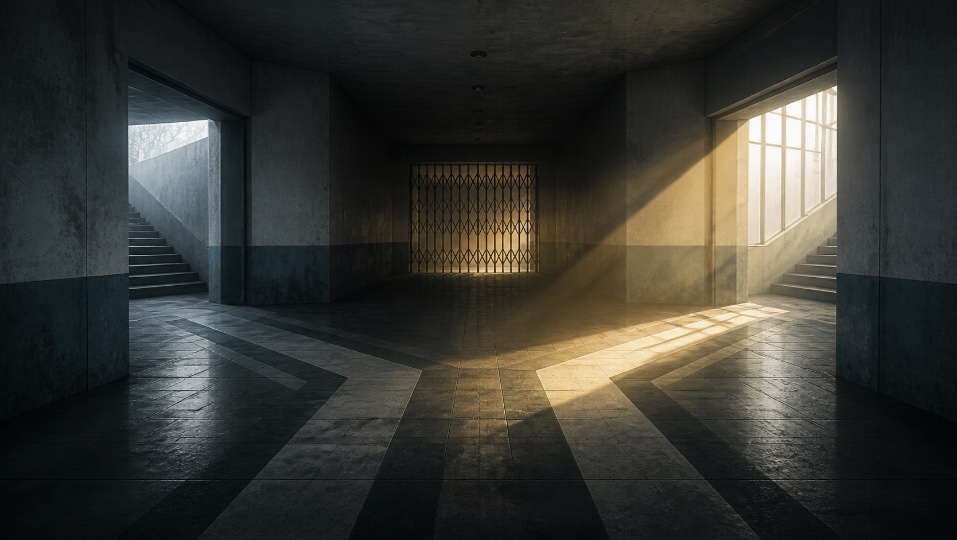
Scout for Rules, Not Just Angles
During a scout, crews naturally note power, access, light, parking and camera positions. Writers and directors can add another list: what can be heard, who can be seen, which route is fastest, where privacy disappears and what changes after dark. These are dramatic rules hiding inside practical observations.
Suppose two characters must exchange information in a public building. A wide lobby offers no cover, so they cannot stand together. A security desk controls the lift, so one of them must choose whether to use a false name. A closing announcement shortens the scene. None of these details requires extra exposition; the place supplies the obstacle.
Do not collect colourful details without testing their effect. Peeling paint may help the frame, but a staircase with a broken middle light can change blocking, recognition and risk. The useful detail is the one that creates a decision or makes an existing decision more costly.
Run a Location Pressure Pass Before Shooting
After the scout and before the shooting draft, read each scene using four constraints: access, distance, sound and weather. Access asks who can enter and what permission costs. Distance asks how long movement takes and who can observe it. Sound asks what must be whispered, repeated or left unsaid. Weather asks which plan no longer works once conditions change.
Change only one constraint in the first pass. If every variable shifts at once, the rewrite may become busy rather than specific. Let a long corridor delay an apology. Let a loud fan force a confession closer than either person wants. Let freezing rain turn a patient wait into an urgent decision.
Context-first conversations provide an unexpected but useful comparison. Palaura is publicly framed around letting people explain priorities in their own words. A filmmaker can apply the underlying sequence during a scout: ask what the scene needs emotionally before sorting the place into conventional categories such as “office,” “house” or “street.”
A generic category invites a generic scene. “A place where the character can leave unnoticed but cannot hear the warning” is a more productive brief than “an attractive restaurant.” It gives the location manager alternatives and gives the writer a reason to care about the physical layout.
Let Screen Geography Replace Spoken Explanation
Screenplays sometimes explain a relationship that blocking could reveal. Two siblings who no longer trust each other do not need to announce the distance between them if the location makes one refuse the available seat. A junior employee can show new authority by using a door previously closed to them.
Consider the contrast built into Palaura — Alternative to Speed Dating Apps, where conversation is positioned against swiping and timed introductions. Film scenes have their own speed problem: a quick establishing shot can label a place without letting the audience experience its rules. A few seconds of purposeful movement can instead show who knows the shortcut, who hesitates and who is being watched.
Geography can also carry reversal. A room that felt safe in daylight becomes exposed at night. A landmark used for orientation disappears in fog. A familiar neighbourhood changes when construction closes the usual route. The character now has to update a plan in front of us, which turns setting into action.
Protect the Location’s Role in the Edit
If a setting creates the scene’s pressure, coverage must preserve that relationship. A tight close-up may capture performance but erase the closing gate, approaching bus or distance to the exit. Identify the shot that makes the physical rule legible and protect it during the schedule.
This does not require constant wides. A glance can connect the character to an off-screen route if the audience has already learned the layout. Sound can keep a threat present after it leaves the frame. What matters is continuity of pressure: the audience should understand why the character cannot simply choose the easier option.
A memorable location is not merely the place where the scene was photographed. It is a system of limits and opportunities that shapes behaviour. Scout its rules, pressure-test the draft and let geography do some of the writing. When the place forces a choice, the story could not happen in quite the same way anywhere else.