


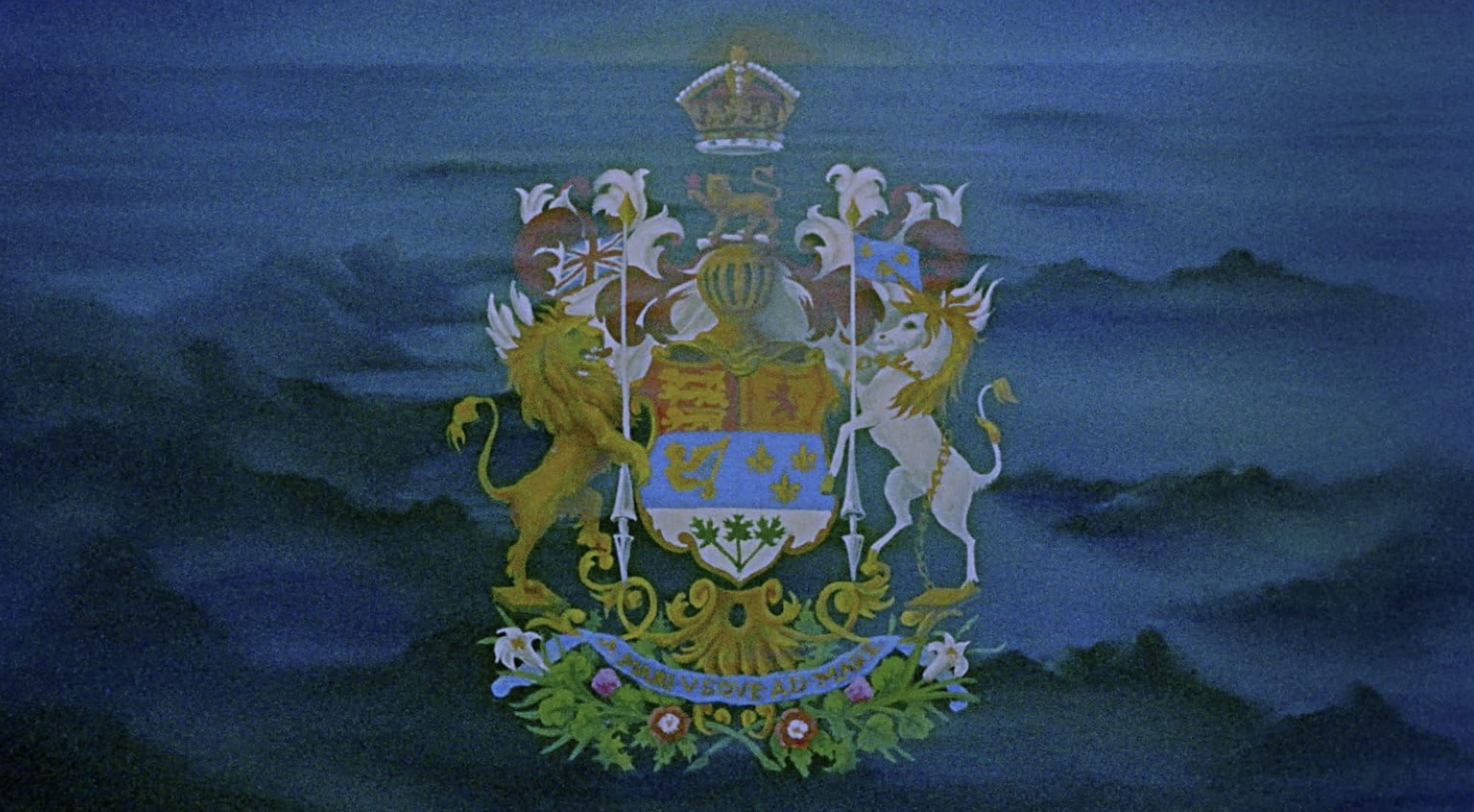
A film barely one minute long can still leave a mark on cinema history. Evelyn Lambart’s O Canada, made at the National Film Board of Canada in 1952, did exactly that. The stereoscopic animation used drawings, changing scale and an unusual “travelling zoom” to create a trip across Canada. The film was tiny in length, but the visual method behind it travelled much further.
What Exactly Is O Canada?
O Canada is an animated short film, made in 1952, directed and animated by Evelyn Lambart, and produced by Guy Glover. According to the National Film Board of Canada, it’s a very short stereoscopic film, in which drawings are used to make Canada’s landscape (changing) suggest movement. It’s 1 minute long on IMDb and has been produced by NFB.
The film stands out in Canadian Cinema as one that relies on no dialogue, characters or typical plot. Instead, it takes the viewer through a sequence of drawn Canadian scenes. Scale changes create the feeling of moving forward through the country. The result is closer to a visual journey than a story. That simple structure also makes the film useful for studying how movement can be created from still artwork.
The “Travelling Zoom” at the Centre of the Film
The main technical idea in O Canada is the “travelling zoom”. Norman McLaren invented the technique in 1937, years before Lambart used it in this film. Government of Canada material about the NFB describes O Canada as an experimental stereoscopic trip that makes use of McLaren’s method.
The technique instead of filming a regular shot and zooming with a camera lens, allows the scale and position of the piece of art. Its effect depends on three linked actions:
- one image increases or decreases in size;
- another image can appear within or beyond it;
- the change in scale creates the sense of moving through the drawing.
This makes the movement feel more like travelling through visual space than watching a standard camera zoom.
How Evelyn Lambart Turned the Technique Into a Canadian Journey
Lambart used the travelling zoom to connect separate views of Canada without relying on normal scene changes. Drawn landscapes lead into one another, so distance becomes part of the animation itself. The NFB describes the short as a trip through Canada’s countryside, and the visual movement supports that idea directly.
This is important when discussing authorship. McLaren created the travelling zoom, but Lambart directed and animated O Canada. She applied the method to a specific film and shaped it into a geographic journey. Her work also came from direct experience with stereoscopic animation. The NFB records that Lambart worked on McLaren’s earlier 3D films Now Is the Time and Around Is Around.
Why O Canada Was Also an Early 3D Experiment
The film was not designed only as a flat animation. It was stereoscopic, meaning separate visual information was prepared for the viewer’s left and right eyes to create a sense of depth. The NFB still classifies O Canada as a stereoscopic film.
Its release followed two important NFB 3D shorts from 1951, Now Is the Time and Around Is Around. Those films were commissioned for the Festival of Britain. In Now Is the Time, the NFB explains that stereoscopy was created by photographing or drawing separate images for each eye with controlled changes in the position of the elements.
Against that background, O Canada was part of a short but active period of early Canadian 3D animation experiments.
How the Travelling Zoom Outlived O Canada
The most striking part of the film’s history came later. According to the National Film Board and the Government of Canada, the travelling zoom used in O Canada was later adapted to help create the famous star-gate sequence in Stanley Kubrick’s 2001: A Space Odyssey.
That does not mean O Canada directly created Kubrick’s sequence. The link is the technique itself. The zoom concept, which McLaren had developed in 1937, was utilized by Lambart in O Canada (1952) and later by an even bigger visual effects production. That is why the short is a valuable lesson in the life of a film technique that can live on after its original film. Even if some films are not so popular, methods can get along.
What O Canada Shows About Early Canadian Experimental Animation
In some ways, O Canada is a proof of how animation can be a sandbox to play with ideas that might be more difficult to test in a film. Lambart didn’t have much time to develop the plot or characters so he focused on scale, depth, movement and transitions.
That’s also why early experimental animation is worthy of today’s filmmakers’ interest. The travelling zoom was not reliant on digital compositing, 3D software or computer generated images. The effectiveness was derived from the meticulous control of artwork, photography and spatial change.
In 2014 it was restored by the NFB to celebrate the 100th birthday of the NFB founder, Norman McLaren. This restoration enabled the first screening of the stereoscopic version, as well as the re-studying of the visual style of the film. The restoration enabled the first screening of the stereoscopic version of the film and re-studying of the visual style of the film. In over seven decades since that film, its core concept has remained as relevant as ever: technique can last longer than run time.
Summary
Evelyn Lambart’s O Canada is a 1952 NFB stereoscopic animation lasting about one minute. It uses drawings and Norman McLaren’s travelling zoom to create the feeling of moving through Canadian landscapes. It was invented by McLaren in 1937, and was related to the visual approach used in 2001: A Space Odyssey, which used the star-gate sequence. In 2014, O Canada was restored and is still a small yet impressive example of early Canadian 3D animation and a showcase on how a simple visual approach can shape the process of making films beyond its original film.