


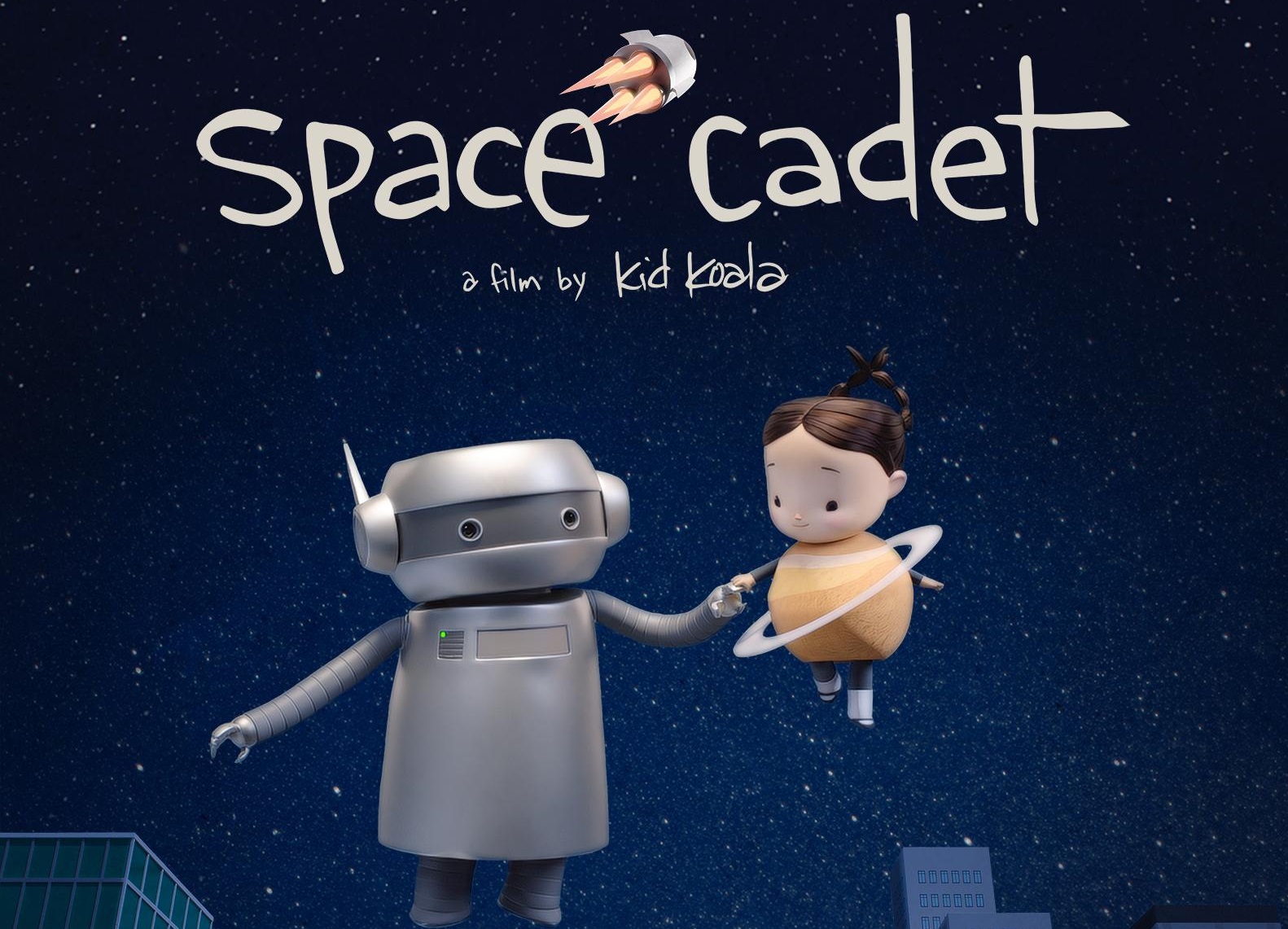
Animation often speaks through movement, colour, and sound, but Space Cadet takes that idea further by telling its story without spoken dialogue.
Directed by Kid Koala in his feature directorial debut, this Canadian animated film explores love, loss, and connection across generations. Adapted from his 2011 graphic novel and written for the screen by Mylène Chollet, the film follows young astronaut Celeste and the guardian robot who raised her as they face separation and change.
Through music-driven animation and visual storytelling, Space Cadet transforms a simple space adventure into a thoughtful reflection on family, purpose, and finding one’s place in the universe.
The Journey from Graphic Novel to Animated Film
Space Cadet began as Kid Koala’s 2011 graphic novel, a quiet visual story centered on companionship, exploration, and emotional connection. More than a decade later, the story was transformed into an animated feature that expands those ideas through movement, music, and atmosphere.
Production began in 2023, with Mylène Chollet adapting the original story for the screen. Rather than relying on traditional dialogue-driven storytelling, the filmmakers created a dialogue-free musical fable where emotions are expressed through character movements, visual details, and sound.
The decision to avoid spoken dialogue became one of the film’s defining creative choices. The relationship between Celeste and Robot is built through gestures, memories, and moments of care rather than explanations. This allows the film to communicate across languages and cultures while emphasizing universal experiences such as love, separation, and personal growth.
Although the story takes place in a futuristic world of space exploration, Space Cadet is less interested in technology than in the emotional journeys that define human life. Space becomes a metaphor for change, uncertainty, and the search for meaning.
Kid Koala’s Vision
Before becoming a filmmaker, Kid Koala (Eric San) built his career as a musician, composer, and multimedia artist. His work has always combined sound and visual storytelling, making animation a natural extension of his creative approach.
In Space Cadet, music is not simply a background element; it becomes part of the film’s emotional language. Without dialogue, rhythm and melody guide the audience through moments of wonder, loneliness, hope, and discovery.
Kid Koala has described the film as an “ode to love and life” and a “tomorrow-days lullaby about finding your place in the universe.” That description captures the film’s unique balance between science fiction and emotional intimacy. While its setting involves astronauts, robots, and distant worlds, its central questions are deeply personal: How do we handle change? What remains after someone leaves? Where do we find purpose when life moves in a new direction?
The result is a film that feels closer to a visual poem than a traditional animated adventure. Its emotional power comes not from dramatic conflicts, but from the quiet connections between characters.
The Plot
At the center of Space Cadet is the relationship between Celeste, a young astronaut preparing for her first interstellar mission, and Robot, the guardian who raised her and helped shape her into the scientist she becomes.
When Celeste leaves Earth to pursue her dream, Robot is left behind. Although he is proud of her achievements, he must face a new reality without the purpose that defined his existence. Meanwhile, Celeste’s mission presents unexpected challenges, forcing her to rely on memories of the lessons and support she received during childhood.
Rather than focusing on space exploration as an adventure, the film uses the cosmos as a backdrop for a more personal story. It examines what happens when the people we love grow beyond us and how relationships continue to influence us even across distance.
Exploring the Film’s Central Themes
Grief and Learning to Let Go
One of the film’s most powerful ideas is the difficulty of accepting change. Robot’s experience reflects a feeling familiar to many caregivers: watching someone they love become independent while trying to understand their own new role.
Celeste’s departure represents both success and loss. Robot has accomplished his mission, but that achievement also forces him to question who he is without the responsibility that once defined him.
The film suggests that separation does not erase connection. The memories, lessons, and love shared between people continue to shape their lives long after circumstances change.
Family Beyond Biology
Space Cadet also explores a broader definition of family. Robot is not Celeste’s biological parent, yet their relationship carries the emotional depth of a parent and child. Their bond is built through years of care, protection, and encouragement.
By focusing on a human and an artificial being, the film challenges traditional ideas about emotion and connection. It suggests that compassion and attachment are not limited by biology but are created through shared experiences and commitment.
Finding Purpose After Change
Robot’s journey raises an important question: What happens when the role that defined us is no longer needed?
The film does not suggest that purpose disappears when circumstances change. Instead, it shows that purpose can evolve. The care and guidance Robot gave Celeste continue to exist through the person she becomes.
The Power of Silent Storytelling
The absence of dialogue is one of Space Cadet’s greatest strengths. In a world where many animated films rely heavily on conversation and humor, Kid Koala creates an experience driven by images, music, and emotion.
Small gestures become meaningful. A look, a movement, or a shared moment can communicate feelings that words might struggle to express. The silent format allows audiences to focus on the emotional relationship between the characters rather than simply following conversations.
Music becomes the film’s voice. Kid Koala’s score shapes the emotional atmosphere of each scene, guiding viewers through moments of sadness, wonder, and hope. The combination of animation and sound creates the feeling of a visual symphony where every detail contributes to the story.
The film’s silence is not an absence; it is a space for reflection. By slowing down and allowing moments to breathe, Space Cadet captures emotions that are often difficult to express directly.
Animation Style and Visual Design
The visual approach of Space Cadet reflects the film’s emotional philosophy: simplicity can be powerful. Instead of relying on overwhelming spectacle, the animation focuses on atmosphere, character design, and meaningful details.
Celeste and Robot’s designs communicate their personalities and relationship without dialogue. Celeste represents curiosity and exploration, while Robot’s appearance reflects warmth and familiarity despite his mechanical nature.
The film’s space environments also serve a symbolic purpose. The vastness of the universe mirrors the characters’ emotional journeys, representing both loneliness and possibility.
Because the story relies heavily on visuals, small details become essential. Movements, expressions, and quiet interactions reveal the depth of the characters’ relationships. The result is an animated world that feels both futuristic and deeply human.
Festival Recognition and Critical Response
Space Cadet premiered at the 75th Berlin International Film Festival in February 2025 in the Generation Kplus section. It later competed in the Contrechamp competition at the Annecy International Animation Film Festival and made its North American premiere at the Toronto International Film Festival.
The film continued its festival journey through events including Festival du nouveau cinéma and the Valladolid International Film Festival. It was also selected for TIFF’s Canada’s Top Ten list for 2025.
Its recognition included a nomination for the Generation Kplus Crystal Bear for Best Feature Film at Berlin, an Annecy Contrechamp nomination, a runner-up placement for Best Animated Film from the Toronto Film Critics Association, and a Youth Jury Prize at Rendez-vous Québec Cinéma.
These achievements reflect the film’s ability to connect with audiences through a unique artistic approach. Rather than competing through scale or spectacle, Space Cadet stands out through emotional honesty and creative restraint.
Why Space Cadet Stands Out
In modern animation, where many films emphasize speed, humor, and visual excess, Space Cadet offers something different. Its strength comes from intimacy rather than scale.
The film uses science fiction not to explore technology alone, but to examine what makes relationships meaningful. The robot’s connection with Celeste raises questions about identity, emotion, and whether purpose can change over time.
As a directorial debut, the film showcases Kid Koala’s distinctive artistic voice. His background in music shapes every aspect of the experience, creating a seamless connection between sound, animation, and emotion.
By choosing silence over spectacle, Space Cadet proves that animated films can be powerful through simplicity. Its story is small in scale but universal in meaning, a reminder that the relationships that shape us remain part of who we are.
Wrapping Up
Space Cadet is a beautifully crafted animated film that demonstrates the emotional possibilities of silent storytelling. Through the relationship between a young astronaut and her guardian robot, Kid Koala explores love, memory, loss, and the search for purpose.
Its greatest achievement is finding depth in quiet moments. Rather than relying on dramatic speeches or large-scale conflicts, the film focuses on the connections that define our lives.
With its blend of music, animation, and emotional storytelling, Space Cadet stands as a memorable Canadian animated feature and a reminder that sometimes the quietest stories can leave the strongest impression.