


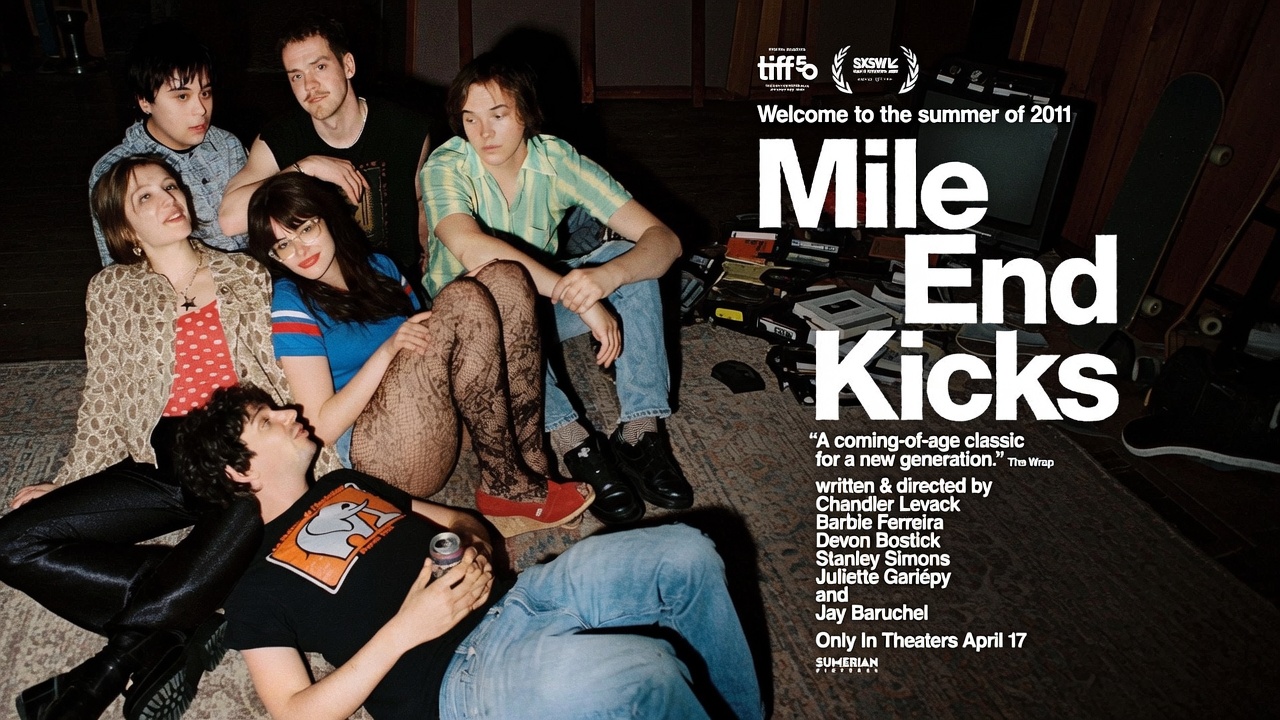
Mile End Kicks is more than a coming-of-age romance; it is a snapshot of a particular moment in Canadian youth culture. Written and directed by Chandler Levack, the film follows an aspiring music critic who leaves Toronto for Montreal in search of creative success, only to find herself caught between artistic ambition, complicated relationships, and the realities of early adulthood. Inspired in part by Levack’s own experiences, the story captures the uncertainty, excitement, and self-discovery that define life in your twenties.
Set against the backdrop of Montreal’s vibrant Mile End neighbourhood and its thriving indie music scene, Mile End Kicks blends romance, comedy, and heartfelt drama with an authentic sense of place.
Rather than idealizing youth, the film embraces its awkwardness, mistakes, and growing pains, exploring everything from financial insecurity and creative frustration to the challenge of finding your own voice in competitive artistic circles.
A Story Inspired by Real Life
One of the reasons Mile End Kicks feels so genuine is that its story draws directly from Chandler Levack’s own experiences. Before becoming an acclaimed filmmaker, Levack built a career as an arts and entertainment journalist, writing for publications including Toronto Life, SPIN, The Globe and Mail, and the Toronto Star.
Like her protagonist, she spent her early twenties immersed in Canada’s independent music scene, navigating creative ambitions, uncertain career prospects, and the often-blurred lines between professional and personal relationships.
That personal connection is reflected in Grace Pine, a young music critic whose move from Toronto to Montreal is motivated by dreams of becoming a successful author. Although Grace arrives with a clear goal, writing a book about Alanis Morissette’s Jagged Little Pill, her plans quickly unravel as she becomes entangled with the members of an emerging indie rock band and increasingly distracted from the work that brought her there in the first place.
Rather than following a conventional path to success, Grace’s journey is shaped by poor decisions, financial stress, romantic disappointments, and moments of painful self-reflection.
What makes the character compelling is her imperfection. Grace isn’t presented as an idealized heroine who always makes the right choices. She is ambitious but impulsive, confident one moment and deeply insecure the next. Levack allows her protagonist to make mistakes without judgment, creating a portrayal that feels honest instead of manufactured. The result is a coming-of-age story that recognizes growth as a messy, nonlinear process rather than a series of neatly resolved life lessons.
By grounding the film in experiences she understands firsthand, Levack captures the emotional uncertainty of early adulthood with remarkable authenticity.
Whether it’s struggling to establish a creative career, searching for meaningful relationships, or learning to recognize one’s own worth, Mile End Kicks reflects challenges that extend well beyond its specific setting. The film ultimately becomes less about one aspiring writer’s summer in Montreal and more about the universal experience of trying to figure out who you are while the future remains frustratingly unclear.
Toronto and Montreal: Two Cities, One Identity
Although much of Mile End Kicks unfolds in Montreal, the story’s emotional foundation begins in Toronto. Grace arrives in Montreal carrying the expectations, ambitions, and frustrations she developed while working as a young music critic in Toronto’s competitive media landscape. Her decision to leave isn’t simply about changing cities; it’s an attempt to reinvent herself creatively and prove that she can build a meaningful career on her own terms.
Toronto represents structure and aspiration. It’s where Grace establishes herself professionally, but it’s also where she feels constrained by unhealthy workplace dynamics and stalled opportunities.
The move to Montreal promises a fresh start, allowing her to step outside familiar routines and immerse herself in a creative community that feels more spontaneous and collaborative. In many ways, Toronto symbolizes the career she wants, while Montreal represents the life she imagines will help her achieve it.
Montreal’s Mile End neighbourhood plays a far more significant role than simply serving as the film’s backdrop. Long associated with independent music, artists, writers, and creative entrepreneurs, Mile End becomes a character in its own right.
Loft parties, intimate music venues, shared apartments, and neighborhood cafés create an environment where friendships, romances, and artistic collaborations naturally intersect. The setting reinforces the feeling that anything might happen, even if not everything turns out as planned.
The contrast between the two cities also reflects Grace’s internal journey. Toronto is tied to professional ambition and the pressure to succeed, while Montreal offers experimentation, freedom, and the possibility of failure without immediate consequences.
As Grace becomes more immersed in Mile End’s indie scene, she gradually discovers that creative fulfillment isn’t simply about achieving a career milestone; it also requires developing confidence, resilience, and a clearer understanding of who she wants to become.
Rather than presenting one city as superior to the other, Chandler Levack uses both Toronto and Montreal to explore different stages of young adulthood. Together, they create a distinctly Canadian coming-of-age story, one rooted not only in geography but in the cultural spaces where artists, musicians, and writers search for opportunity, community, and identity.
Barbie Ferreira Leads a Strong Ensemble
A coming-of-age story succeeds or fails on the strength of its central performance, and Mile End Kicks is anchored by Barbie Ferreira’s portrayal of Grace Pine. Ferreira brings warmth, vulnerability, and emotional honesty to a character who is often impulsive, occasionally frustrating, and consistently believable.
Devon Bostick delivers an equally compelling performance as Archie Webber, the thoughtful guitarist whose quiet sincerity provides a striking contrast to the louder personalities surrounding him. Archie isn’t portrayed as the stereotypical “nice guy” waiting in the wings. Instead, he is given emotional depth and personal vulnerabilities that make his connection with Grace feel genuine rather than inevitable. Their relationship develops through shared conversations, mutual understanding, and gradual trust instead of relying on familiar romantic clichés.
Stanley Simons, meanwhile, embodies the charismatic but self-absorbed Chevy Olsen with just the right balance of charm and arrogance. Chevy represents the allure of creative success and confidence that initially draws Grace into Bone Patrol’s orbit, while also illustrating the emotional immaturity that often accompanies youthful ambition. His interactions with Grace expose some of the film’s most important themes surrounding self-worth, power dynamics, and the dangers of seeking validation from others.
The supporting cast further enriches the story. Juliette Gariépy’s Madeleine serves as both Grace’s roommate and an important voice of honesty, challenging her when her choices begin to affect those around her.
Jay Baruchel makes a memorable appearance as Jeff, Grace’s former editor, whose professional and personal relationship with her highlights the gendered power imbalances that the film explores throughout its narrative. Together with Robert Naylor, Isaiah Lehtinen, and the rest of the ensemble, the cast creates a believable creative community where friendships, rivalries, romances, and artistic ambitions naturally overlap.
What ultimately makes the performances stand out is their restraint. Rather than relying on exaggerated comedy or melodrama, the cast allows awkward silences, uncomfortable conversations, and small moments of vulnerability to carry emotional weight. That understated approach complements Chandler Levack’s writing and helps make Mile End Kicks feel like an authentic portrait of young adulthood instead of a polished Hollywood fantasy.
Chandler Levack’s Growth as a Filmmaker
With Mile End Kicks, Chandler Levack continues to establish herself as one of Canada’s most distinctive contemporary filmmakers. While her debut feature, I Like Movies, explored adolescence through the lens of a movie-obsessed teenager, her second feature shifts its focus to the uncertainty of early adulthood.
Both films share an interest in flawed but deeply human protagonists who are searching for purpose, yet Mile End Kicks demonstrates a filmmaker growing more confident in both her storytelling and visual style.
One of the most noticeable developments is the film’s expanded scope. Produced on a budget of approximately $4 million, significantly larger than the roughly $130,000 budget for I Like Movies, Mile End Kicks gives Levack the opportunity to create a richer cinematic world without losing the intimacy that defined her earlier work.
The larger scale is evident in the film’s vibrant recreation of Montreal’s indie music scene, its ensemble cast, and its polished production values, but the emotional focus remains firmly on character rather than spectacle.
Levack’s background as an entertainment journalist also continues to shape her storytelling. Rather than relying on exaggerated drama or sentimental clichés, she writes from lived experience, paying close attention to the awkward conversations, career frustrations, and emotional contradictions that often define young adulthood.
Her characters are rarely heroic or villainous; instead, they make poor decisions, misunderstand one another, and gradually learn from their mistakes. That commitment to emotional authenticity has become one of the defining characteristics of her filmmaking.
Critics have recognized this artistic growth. Following its premiere at the Toronto International Film Festival, Mile End Kicks earned generally favorable reviews and was praised for its honest writing, memorable performances, and confident direction.
The film was later included in TIFF’s annual Canada’s Top Ten list and received multiple award nominations, including recognition for Levack’s screenplay and directing. These accolades suggest that Mile End Kicks is not only a successful follow-up to I Like Movies but also another significant step in Levack’s evolving career.
Critical Reception
Following its world premiere at the Toronto International Film Festival (TIFF) on September 4, 2025, Mile End Kicks quickly established itself as one of the year’s most talked-about Canadian films.
Critics responded positively to the film, praising its emotionally honest portrayal of young adulthood and its refusal to romanticize the struggles of creative life. Review aggregator Rotten Tomatoes reports an 87% approval rating from critics, while Metacritic assigned the film a score of 77 out of 100, indicating “generally favorable” reviews. Although reviewers acknowledged that the film’s loose narrative occasionally meanders, many agreed that its authenticity, performances, and sharp observations more than compensate for its unconventional structure.
Much of the praise focused on Barbie Ferreira’s lead performance and Chandler Levack’s confident direction. Critics highlighted Grace Pine as an unusually nuanced coming-of-age protagonist, someone whose flaws, ambitions, and vulnerabilities feel authentic rather than manufactured.
Levack also received recognition for her ability to recreate the atmosphere of Montreal’s indie music scene without relying on nostalgia alone, instead presenting it as a vibrant but imperfect community filled with creative energy and personal contradictions.
The film’s soundtrack and cultural specificity also earned widespread acclaim. Reviewers noted how Mile End Kicks captures the spirit of Canada’s early-2010s indie rock era, using original music and carefully observed details to immerse viewers in a world that feels lived-in rather than recreated. For audiences familiar with Montreal’s music scene, or simply with the uncertainty of pursuing creative ambitions, the film’s setting became one of its greatest strengths.
Beyond critical reviews, Mile End Kicks received recognition during awards season. It was named to TIFF’s prestigious Canada’s Top Ten list for 2025 and earned numerous nominations at the Canadian Screen Awards and the Vancouver Film Critics Circle Awards.
The film won Canadian Screen Awards for Best Editing and the Sustainable Production Award, while Devon Bostick received the Vancouver Film Critics Circle Award for Best Supporting Actor in a Canadian Film. These honors reflect the industry’s appreciation not only for the film’s storytelling but also for its technical craftsmanship and ensemble performances.
Although Mile End Kicks was a modest performer at the box office, its warm critical reception and growing list of accolades suggest it has found lasting value as a character-driven portrait of creative ambition and early adulthood.
Wrapping Up
Ultimately, Mile End Kicks is much more than a typical coming-of-age film; it is a beautifully messy, authentic time capsule of Canadian youth culture. By leaning into her signature emotional honesty and drawing from personal history, Chandler Levack delivers a sophomore feature that rejects polished Hollywood endings in favor of real, relatable growth.
Anchored by Barbie Ferreira’s raw, vulnerable performance and a brilliant supporting cast, the film captures the sharp, bittersweet friction between who we are and who we want to become. Whether you have navigated the creative hustle of Toronto, gotten lost in the romanticized alleyways of Montreal, or simply survived the chaotic uncertainty of your twenties, Mile End Kicks stands as a resonant, beautifully soundtracked reminder that finding your voice is always a work in progress.