


Film festival marketing starts the day the acceptance email arrives. A festival gives your film a screen and a time slot, but it does not promise an audience. With dozens of titles competing for the same evening, the films that fill their seats are usually the ones people kept seeing in the days before: on a wall, on a café counter, in someone’s hand. These eight print ideas follow the order of a festival run, from the weeks before your first screening to the days after your last.
Why Print Still Works for Film Festival Marketing
Social posts reach the people who already follow you. Print reaches the people who are physically at the festival, deciding what to watch next. A poster in a lobby or a postcard handed over in a ticket line meets the audience at the exact moment they are choosing.
Print also suits how festivals work. Runs are short, budgets are small and plans change late. For a short festival run, a print shop such as https://fivedprint.com/ can turn around posters, flyers and banners in small quantities, with rush printing available when the schedule shifts. That means you can order what one festival needs and reprint for the next.
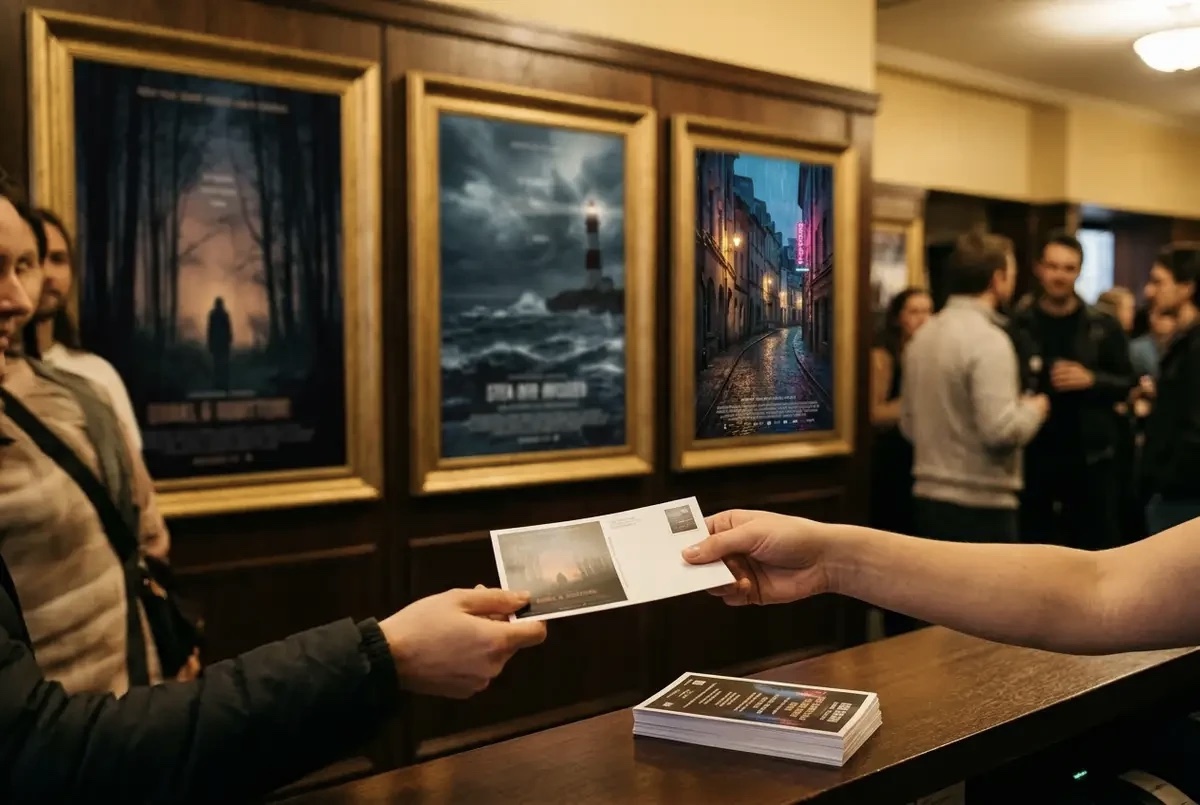
1. One-Sheet Film Poster Printing for Venues and Lobbies
The poster is the face of the film. Most festivals ask for at least one, and many display them in the lobby or outside the screening room. The traditional one-sheet measures 27″ x 40″, though plenty of venues accept 24″ x 36″, so check the festival’s requirements before ordering. Keep the design simple enough to read from across a room: a strong image, the title, a tagline and the credit block. Order a few smaller 11″ x 17″ copies as well. They fit shop windows and notice boards where a full one-sheet will not. Matte paper cuts glare under lobby lighting, while gloss gives dark, moody stills more depth. Bring a spare in a tube in case one is damaged on the way.
2. Flyers and Postcards With Your Screening Times
If the poster creates interest, the postcard closes the deal. Put a striking still on the front and the practical details on the back: a two-line synopsis, the date, time and venue of each screening, and a QR code that opens the ticket page. Flyer printing on a heavier card stock works well here, because a sturdy card survives a pocket or a tote bag. A 4″ x 6″ card is the usual size, and if the film screens twice, list both times so one card works all week. Hand them out in line-ups, after other screenings and at festival parties, and ask nearby cafés and bookshops if you can leave a small stack.
3. A Printed Press Kit Booklet for Media and Programmers
Journalists, programmers and distributors are offered links all day. A printed press kit gives them something that stays on the desk. A short saddle-stitched booklet can hold the logline and synopsis, a director’s statement, cast and crew biographies, production stills, key credits, the running time and your contact details. Keep it to eight or twelve pages, since saddle-stitched booklets are built in multiples of four. Booklet printing in a short run keeps the cost under control, since you only need copies for the people you plan to meet. Add a QR code on the back cover that links to the digital press kit and downloadable stills.
4. Banner Printing for Q&As and Photo Walls
When the lights come up for the Q&A, the audience photographs whatever is on stage. A roll-up banner with the film’s title and key art puts your branding in every one of those photos, and it packs into a carry case for the next festival. For premieres and receptions, a wider backdrop with the title repeated across it gives cast and guests a place to be photographed. Banner printing works best with bold, simple artwork, so leave out small text that nobody can read from the back of the room. Check with the venue first, since some stages have limited floor space and their own rules for signage.
5. Custom Stickers That Travel Beyond the Venue
Stickers are the cheapest item on this list and often the one that travels farthest. A die-cut sticker of the title treatment or a memorable image ends up on laptops, water bottles and notebooks, where other festival-goers keep seeing it. They also make an easy gift when someone asks about the film. A weatherproof vinyl holds up better than paper on bottles and cases. Keep them off venue walls and doors, though, because that costs you goodwill with the festival. Sticker printing has a practical use as well: a small label with a new screening time or an award laurel can update postcards and posters you have already printed.
6. Business Cards With a QR Code to the Trailer
Festivals run on conversations in hallways and queues, and most of them last under a minute. A business card finishes the conversation for you. Print your name, your role, the film’s title and your contact details, and add a QR code that opens the trailer or the film’s website. Choose an uncoated or matte stock for the back and leave some blank space. People often write a note on a card to remember where they met you, and that is hard to do on a glossy surface. Hand one over at the end of every conversation, and collect theirs in return.
7. Reprinted Posters With Laurels and Review Quotes
A festival selection is news, and an award or a strong review is better news. Update the poster as soon as you have either one. Laurels along the top and a short quote from a critic tell the next audience that someone else has already vouched for the film. Keep the quote to four or five words and credit the publication. Ask your designer to leave room for these in the original layout so the update takes minutes. Poster printing in small quantities makes this practical, since you replace only the copies you need for the next stop.
8. Thank-You Cards for Cast, Crew and Backers
The run does not end with the last screening. A printed thank-you card with a still from the film and a handwritten line goes to the people who made it possible: cast, crew, crowdfunding backers, festival staff and the programmer who selected you. It costs little, and it is remembered when you come back with the next project. Send the cards within a week or two, while the festival is still fresh. Postcards left over from the festival can do the same job, and signed mini-posters make a good reward for supporters.
Ordering Festival Print: Quantities and Deadlines
Two questions come up with every order: how much to print and how late you can leave it.
How Many Copies a Short Festival Run Needs
Print for one festival at a time. Flexible quantities matter here, so ask whether the shop will print ten of one item as readily as five hundred of another. As a rough guide, a handful of posters covers the venue and a few local windows, postcards and stickers go fastest and are worth ordering in the hundreds, and press kits can be limited to the meetings you have booked. Business cards last across several festivals, so a larger batch makes sense. Anything that carries a date or time should be ordered in the smallest quantity, because it is out of date the day after.
Rush Printing When a Screening Slot Is Confirmed Late
Schedules often arrive close to the event. Print the items without dates first, such as posters, stickers, business cards and banners, and hold the postcards until the times are final. To make rush printing work, have print-ready PDF files prepared with bleed and images at 300 dpi, approve proofs quickly and confirm the pickup time when you place the order. Simple finishes are produced faster than specialty ones.
Good print will not replace a good film, but it gets people into the room to see it.