


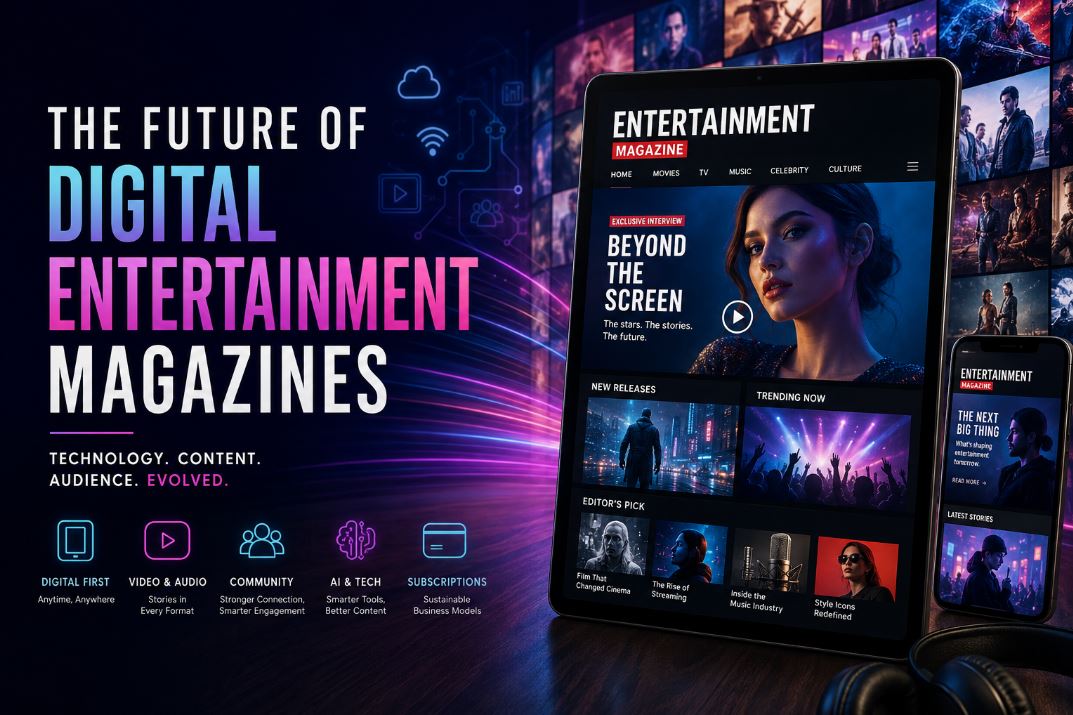
Entertainment magazines have always reflected the way people discover culture. In the print era, readers waited for weekly or monthly issues to learn about new films, television shows, celebrities, music, fashion, and industry developments. Today, audiences expect entertainment coverage to reach them instantly through websites, search engines, social platforms, newsletters, podcasts, videos, and mobile applications.
This shift does not mean the magazine is disappearing. Instead, the meaning of a magazine is changing.
A modern digital entertainment magazine is no longer simply an online copy of a printed publication. It is becoming a continuously updated media brand that combines journalism, commentary, visual storytelling, community participation, and personalized distribution.
The future of digital entertainment magazines will therefore depend on more than publishing a large number of articles. Successful publications will need to develop distinctive editorial identities, produce content in multiple formats, build direct relationships with readers, and use technology without sacrificing originality or trust.
Digital-First Publishing Will Become the Standard
Traditional magazines were organized around publishing schedules. A team would prepare an issue, send it to print, distribute it, and begin working on the next edition.
Digital audiences operate differently. They do not want to wait several weeks for coverage of a film announcement, celebrity interview, award ceremony, streaming release, or major cultural moment. They expect entertainment publications to react while a story is still developing.
As a result, digital-first publishing will continue to replace issue-first thinking. Entertainment magazines will publish breaking stories immediately while also producing interviews, reviews, explainers, opinion pieces, retrospectives, and long-form features that remain valuable after the initial news cycle ends.
This does not mean every publication must become a breaking-news website. Smaller magazines can compete by choosing a clear editorial position. One may specialize in independent cinema, another in celebrity culture, another in streaming television, and another in thoughtful analysis of entertainment trends.
Entertainment Magazines Will Become Multimedia Platforms
Written articles will remain important, but they will no longer be the only format through which readers experience a magazine.
Digital entertainment publications are increasingly competing with YouTube channels, podcasts, streaming platforms, social creators, fan communities, and short-form video accounts. To remain competitive, magazines will need to transform one story into several connected media experiences.
A celebrity interview, for example, could become:
- A complete written feature.
- A short video containing the strongest moments.
- A longer video interview.
- An audio episode.
- A series of social-media clips.
- A photo gallery.
- A newsletter summary.
- A reader discussion or live question-and-answer session.
This approach allows one piece of reporting to reach audiences with different consumption preferences. Some readers want a carefully written profile, while others prefer a five-minute video or an audio conversation they can hear while travelling.
The shift toward video is particularly important. The Reuters Institute’s 2026 Digital News Report found that 77% of respondents across its surveyed markets consumed online news video each week. Although that research focuses on news rather than entertainment publishing specifically, it illustrates the broader movement toward video-led digital consumption.
Entertainment magazines are well positioned to benefit from this trend because their subject matter is naturally visual. Film trailers, red-carpet events, fashion, performance, interviews, set design, music, and celebrity culture can all be presented through video.
However, publishers should not treat multimedia as an excuse to reproduce the same generic content on every platform. Each format should offer something useful. A short video may introduce a story, while the full article provides context, analysis, and original reporting.
Social Platforms Will Be Distribution Channels, Not Permanent Homes
Social platforms help entertainment magazines reach large audiences, but relying completely on them creates significant risks.
Algorithms change frequently. An account that receives strong engagement today may experience a major decline in visibility after a platform update. Publications can also lose access to followers if an account is restricted, removed, or abandoned by users.
The Reuters Institute reported in 2026 that 52% of respondents aged 18 to 24 considered social media, video networks, and AI chatbots their main route to news. The same report found that much of the growth in online video consumption was taking place on third-party platforms rather than publishers’ own websites and applications.
For entertainment publishers, the lesson is clear: social platforms are essential for discovery, but they should lead readers toward channels the publication controls.
Those owned channels can include:
- The magazine’s website.
- An email newsletter.
- A mobile application.
- A subscriber community.
- A membership area.
- Events or online discussion spaces.
A publication may use Instagram to share a visual story, TikTok to publish a short reaction, YouTube for a complete interview, and its website for an authoritative article. The goal should be to create a connected publishing system rather than treating every platform as a separate content operation.
Building an email list will be especially valuable. A newsletter gives a magazine a direct line to readers without depending on a search engine or social-media algorithm. It can also encourage repeat visits, promote subscriptions, and develop a stronger sense of community.
Editorial Identity Will Matter More Than Content Volume
The internet already contains more entertainment content than any individual can consume. Publishing more articles is therefore not enough to create a successful magazine.
The Reuters Institute’s 2025 research warned that audiences already feel overloaded and are unlikely to respond positively to more automated, sensationalized content. Its findings emphasized the continuing value of accuracy, transparency, impartiality, and original reporting.
Entertainment publications face a similar challenge. Readers can find basic plot summaries, celebrity updates, release dates, and trending stories on thousands of websites. A magazine must give them a reason to choose one publication over another.
That reason may be:
- A recognizable editorial voice.
- Better research.
- Exclusive interviews.
- Specialist industry knowledge.
- Stronger visual presentation.
- More thoughtful cultural criticism.
- Clearer explanations.
- A commitment to a particular audience or community.
Digital publications such as The Boring Magazine demonstrate how a distinctive name and accessible editorial approach can help a magazine establish an identity across entertainment, technology, biographies, and related subjects.
Brand identity should influence every part of a publication, including its headlines, design, article selection, photography, social posts, and newsletters. Readers should be able to recognize the magazine’s perspective even before seeing its logo.
This consistency will become increasingly valuable as automated content makes the wider internet feel more repetitive.
Artificial Intelligence Will Change Magazine Workflows
Artificial intelligence is likely to become part of nearly every stage of digital publishing.
Entertainment magazines may use AI tools to:
- Transcribe interviews.
- Organize research notes.
- Translate articles.
- Identify patterns in audience data.
- Recommend related content.
- Generate captions and metadata.
- Improve search functions.
- Create personalized newsletters.
- Assist with audio and video editing.
- Make archives easier to explore.
Reuters, for example, introduced AI-generated live transcription within Reuters Connect in August 2026 to support faster headline writing, scripting, verification, and video publishing workflows.
These tools can reduce repetitive work and allow editorial teams to concentrate on reporting, interviewing, analysis, and creative decisions. They may be especially valuable for smaller digital magazines with limited staff and budgets.
Nevertheless, AI should support editorial work rather than replace editorial judgment.
Entertainment reporting frequently involves rumors, disputed claims, rapidly developing stories, copyrighted material, and sensitive information about public figures. Automatically generated content can reproduce errors, remove necessary context, or present speculation as fact.
Magazines will therefore need clear AI policies covering:
- Which tools can be used.
- How generated material is reviewed.
- When readers should be informed.
- How copyrighted material is handled.
- How sources and facts are verified.
- Which decisions must remain under human control.
The most successful publishers will not necessarily be those that automate the largest amount of work. They will be those that use automation carefully while preserving a recognizable human perspective.
Personalization Will Improve the Reader Experience
Traditional magazines gave every reader the same issue. Digital magazines can offer different experiences based on individual interests.
A reader interested in independent films may receive recommendations for festival interviews and director profiles. Someone who regularly reads television reviews may see more streaming coverage. A music fan may receive a newsletter focused on album releases, artist interviews, and concert features.
Useful personalization could include:
- Recommended articles based on reading history.
- Topic-specific newsletters.
- Custom homepages.
- Saved reading lists.
- Notifications for selected celebrities, franchises, or genres.
- Audio versions of articles.
- Adjustable reading formats.
- Follow-up explainers connected to previous stories.
AI chatbots may also become a new discovery layer. According to the Reuters Institute’s 2026 report, 10% of respondents used AI chatbots for news, increasing to 16% among people under 35. The ability to ask follow-up questions was one of the most valued features reported by users.
An entertainment magazine could eventually allow readers to ask questions such as:
- Which films won major awards this year?
- What should I know before watching the latest sequel?
- Which interviews has this magazine published with a particular actor?
- What are the best new streaming dramas covered this month?
Such tools could make a magazine’s archive more useful. However, personalization should not become surveillance. Publishers will need to explain what information they collect, how it is used, and how readers can control their preferences.
Niche Communities Will Compete With Mass-Market Publications
Digital publishing has lowered the cost of launching a magazine. A publication no longer needs a national printing and distribution operation to reach an international audience.
This creates opportunities for smaller entertainment brands focused on specific interests, such as:
- Independent filmmaking.
- Regional cinema.
- Classic Hollywood.
- Animation.
- Horror.
- Science fiction.
- International television.
- Music subcultures.
- Streaming criticism.
- Celebrity fashion.
- Behind-the-scenes production.
- Emerging actors and directors.
A niche publication may have fewer total readers than a general entertainment website, but its audience can be more loyal and engaged. Advertisers, creators, studios, event organizers, and entertainment businesses may also value access to a clearly defined community.
Platforms such as The Bold Magazine can strengthen their position by developing a confident editorial voice and giving attention to stories, creators, or cultural perspectives that larger publications may overlook.
Community participation will also become a competitive advantage. Readers may contribute questions for interviews, vote in annual awards, join live discussions, recommend stories, or participate in members-only events.
The magazine of the future will not simply publish content at an audience. It will create an environment in which readers feel involved.
Trust and Transparency Will Become Competitive Advantages
Entertainment journalism can be entertaining without becoming unreliable.
Digital publishers often face pressure to publish quickly, write sensational headlines, repeat unverified social-media claims, or present rumors as confirmed news. These practices may create immediate traffic, but they can damage a publication’s reputation.
Future-focused magazines should establish clear standards for:
- Verifying information before publication.
- Distinguishing reporting from commentary.
- Correcting mistakes visibly.
- Labeling sponsored content.
- Crediting original sources.
- Respecting copyright.
- Handling anonymous claims carefully.
- Separating rumors from confirmed developments.
- Disclosing meaningful conflicts of interest.
- Explaining the use of AI-assisted content.
Trust is especially important as search engines, social platforms, and AI systems summarize information without always sending readers to the original publisher. A magazine with a reputation for reliable reporting will have a stronger chance of being cited, recommended, shared, and visited directly.
Human Creativity Will Remain the Main Differentiator
Technology will make publishing faster. It will not automatically make publishing more meaningful.
AI can summarize a press release, generate headline variations, or identify trending topics. It cannot independently build genuine relationships with sources, develop cultural sensitivity, earn the trust required for revealing interviews, or understand why a particular entertainment story matters to a specific community.
The future of digital entertainment magazines will still depend on human qualities:
- Curiosity.
- Taste.
- Judgment.
- Empathy.
- Cultural awareness.
- Investigative ability.
- Original observation.
- Creative risk-taking.
- Strong storytelling.
As basic information becomes easier to generate, distinctive thinking will become more valuable. Readers will be able to find quick summaries almost anywhere. They will visit magazines for interpretation, personality, expertise, discovery, and emotional connection.
Conclusion
The future of digital entertainment magazines will not be defined by the disappearance of traditional publishing. It will be defined by its transformation.
The next generation of entertainment magazines will operate across articles, videos, podcasts, newsletters, social platforms, communities, and interactive tools. They will use artificial intelligence to improve workflows and personalization, but they will still depend on human editors to maintain accuracy, creativity, and trust.
They will also need to become less dependent on unpredictable traffic sources. Direct reader relationships, recognizable editorial identities, organized archives, diversified revenue, and meaningful communities will be essential to long-term growth.
Most importantly, successful digital magazines will understand that the future is not about producing the greatest possible amount of content. It is about producing work that audiences can recognize, trust, enjoy, and remember.
The technology surrounding entertainment publishing will continue to change. The fundamental purpose of a good magazine will not: discovering worthwhile stories and presenting them in a way that makes people want to keep reading.