


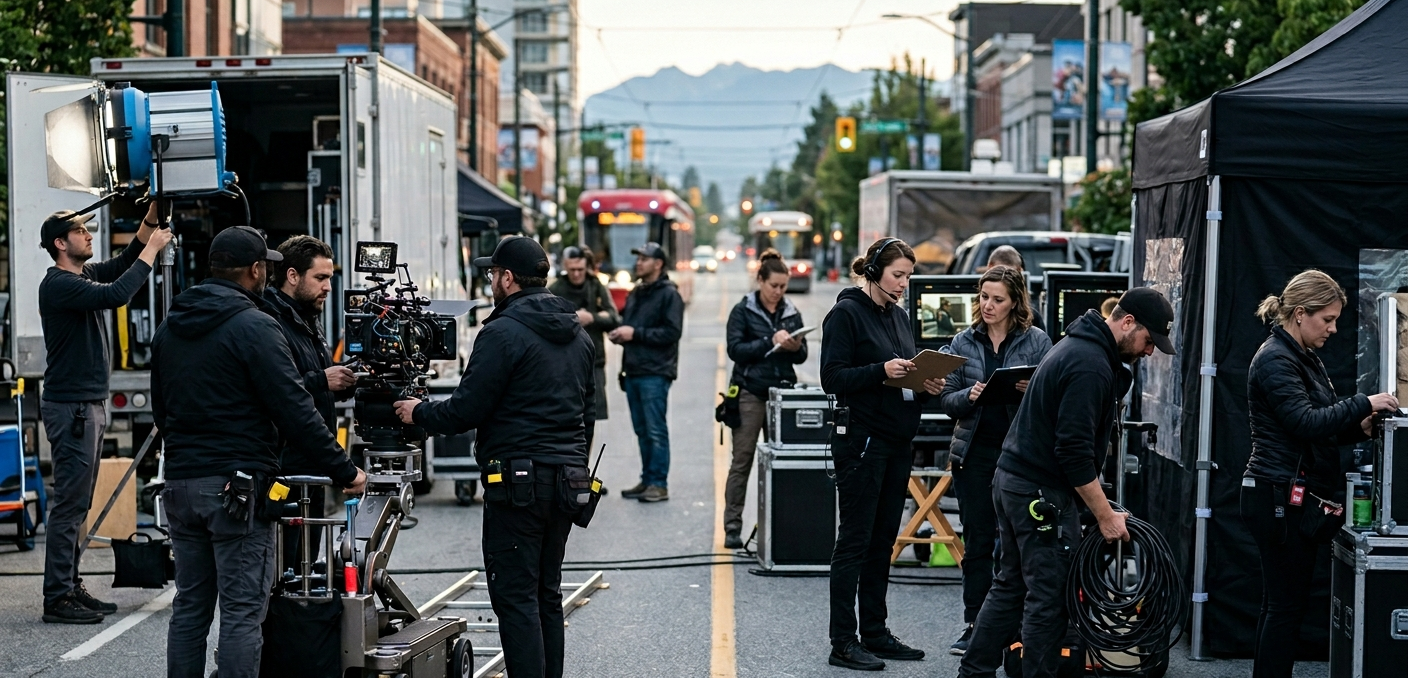
At 4:00 AM, the set is almost silent, save for the faint hum of equipment and the quiet shuffle of a few early risers. By 6:00 AM, the scene transforms completely. Crew members are moving with purpose, grips, electricians, camera operators, all making sure every detail is in place before the first shot.
This is the engine that drives Canada’s film and TV industry, powered by the 87,000+ members of IATSE, the DGC, and the FAIR Coalition. These aren’t just workers on a set; they’re the backbone of an industry that has become a global competitor.
IATSE: The Technical Backbone
The International Alliance of Theatrical Stage Employees (IATSE) has been a cornerstone of Canada’s film and TV industry for well over a century. Founded in 1898, Local 56 in Montreal was one of the first of its kind, setting the stage for a movement that would eventually span the country.
Over the years, IATSE has evolved from a small group of stagehands to a massive, influential force, an essential part of what makes Canada’s entertainment scene tick.
IATSE’s resilience can be seen in the way it has adapted through the digital revolution. What started as a union for theater technicians now encompasses a wide range of highly specialized roles: camera assistants, electricians, makeup artists, riggers, and even more recently, LED wall technicians and digital assets managers.
The union has continuously expanded its scope to match the demands of a changing industry, and today it’s a powerhouse with an enduring legacy.
Local 891 (BC/Yukon) – The Engine Room
For those in the industry, Local 891 represents the beating heart of British Columbia’s film production.
From 2025 to 2028, the BCCFU Master Agreement brought significant changes, with the introduction of Schedules A, B, and C.
These schedules were a game-changer, offering more flexibility for producers while ensuring that the workers’ benefits and fringes remained protected. This new structure allows for budget flexibility without sacrificing the integrity of worker protections, something that has become increasingly important as the industry grows more complex.
Local 873 (Toronto) – Scale & Sophistication
Toronto, Canada’s film capital, represents a different beast entirely. The city’s booming production scene, driven by high-profile international projects like Star Trek and The Boys, demands a level of technical expertise that only a highly skilled workforce can provide.
Here, IATSE Local 873 is a crucial player, ensuring that the technical demands of modern “streamer era” productions are met with precision and skill. The sophistication of these shows means that specialized knowledge, whether it’s handling complex camera rigs or understanding the latest in visual effects technology, has become a must.
The Regional Expansion
One of the most notable trends in recent years has been the decentralization of Canada’s film industry. The 2026 Standard Agreement of IATSE Local 849, which covers Atlantic Canada, exemplifies this shift. No longer are the bulk of high-paying film jobs concentrated in Vancouver and Toronto.
Instead, productions are moving eastward, creating new opportunities for skilled workers in regions that were once overlooked. Local 849’s agreement serves as a model for how smaller markets can thrive by ensuring fair wages, benefits, and working conditions, all while maintaining the highest standards of production quality.
Technical Evolution
As technology advances, so too does the nature of the work IATSE members are doing. Roles once limited to physical labor have expanded into the digital realm, with positions like Volume/LED Wall Technicians becoming more prominent.
These technicians operate the state-of-the-art virtual production environments used for shows like The Mandalorian, where a massive digital set is used to create immersive, interactive environments in real-time.
Digital Asset Managers, too, are now an integral part of the production team, managing the vast amounts of digital content required to build modern visual landscapes. It’s a far cry from the days when a grip’s only concern was hauling heavy equipment around a set.
The evolution is clear: what began with manual labor is now an intricate, tech-driven process that requires advanced training and expertise.
IATSE, with its deep roots and forward-looking approach, remains the technical backbone of Canada’s film and TV industry, ensuring that the crew behind every production is well-prepared, well-protected, and always at the cutting edge.
Without the union’s strong presence and commitment to its members, Canada’s “Hollywood North” wouldn’t be what it is today.
DGC: The Creative & Logistical Architects (~550 words)
Somewhere between the call sheet and the final cut, that’s where the Directors Guild of Canada lives. Not always visible, not always credited in the way audiences might notice, but absolutely everywhere once you know where to look.
As of 2026, the DGC has crossed the 7,000-member mark, spanning more than 90 distinct categories. And that number matters. Not just as a statistic, but as a signal of how layered modern production has become.
Directors, yes, but also assistant directors, location managers, production designers, editors. It’s a wide tent. Has to be.
The 2026–2028 DGC/CMPA Agreement quietly reset expectations across the board. Wages didn’t just inch upward, they climbed, with a compounded growth of roughly 12.5%.
For directors working on Tier A theatrical features, Rights Acquisition Fees now start above $12,300 per week in 2026 and continue to rise each year of the agreement. That’s not a vanity figure. It reflects something deeper: ownership, authorship, and, frankly, a long overdue acknowledgment of creative labor as intellectual property, not just service work.
And then there’s the question of who gets to tell stories.
In January 2026, the DGC released its latest census report. One number stood out: 20.7%. That’s the proportion of members identifying as BIPOC, a threshold the guild had been working toward for years.
It’s easy to treat that as a diversity headline, and sure, it is, but the real shift is subtler. It shows up in the texture of the work. In the choices a production designer makes. In how an editor holds a moment just a second longer. These aren’t surface-level changes. They shape tone, rhythm, perspective.
You can feel it.
Of course, none of this happens in a vacuum. Or in a studio, for that matter.
Take a typical day for a location manager in downtown Toronto. “Typical” might be the wrong word. Controlled chaos is closer. Streets need to be locked off, permits negotiated, residents informed (and occasionally calmed down), traffic rerouted, without bringing the city to a standstill. And it’s never just one variable. Weather shifts. A delivery truck shows up where it shouldn’t. Someone forgets a clearance. Suddenly, the whole day’s schedule starts to wobble.
And yet, somehow, it holds.
That’s the invisible architecture the DGC provides. It’s not just about creative vision; it’s about execution under pressure. Precision, timing, diplomacy. A strange mix, if you think about it. Part artist, part air-traffic controller.
There’s also a kind of quiet authorship embedded in these roles. Editors, for instance, often shape performances as much as actors do, maybe more, on a bad day. Production designers build emotional worlds long before a camera rolls. Assistant directors? They’re the metronome, keeping everything from drifting off tempo.
It’s easy to romanticize directing as the singular vision at the top. But that’s not really how it works anymore. Maybe it never did. The modern set is too complex, too interdependent. The DGC reflects that reality, not as a hierarchy, but as a network.
Messy at times. Human, definitely.
And that’s probably the point.
The AI Frontier: Human-in-the-Loop Oversight
Not long ago, conversations about AI on set had a certain edge to them, uneasy, a bit speculative, sometimes outright alarmist. That tone has softened. Not disappeared, but settled.
In 2026, AI isn’t circling the industry as an abstract threat; it’s inside the workflow, defined, and, crucially, bounded.
Both IATSE and the DGC have drawn fairly clear lines in their latest agreements. Transparency is no longer optional. If AI tools are being used, whether for script breakdowns, previsualization, or post-production enhancements, crews are informed. Consent isn’t implied; it’s required. That alone marks a shift from the ambiguity of just a few years ago.
Still, the real friction point has always been VFX.
The updated “VFX Sideletter,” particularly relevant for IATSE Local 891, tries to address that tension head-on. It recognizes that AI-assisted workflows, environment generation, crowd duplication, even texture mapping, are now part of the process.
But here’s the key: the artists behind those outputs are still credited, still protected. The language is deliberate. AI can assist in building a world, but it doesn’t author it. That distinction matters more than it might seem at first glance.
Because, if we’re being honest, the fear was never about tools. It was about replacement.
So far, that hasn’t materialized in the way many expected. What’s emerged instead is a kind of hybrid model, human-led, machine-assisted.
Editors might use AI to sift through hours of footage faster, but the final cut? That’s still a human decision. Directors may lean on AI for previsualization, testing angles or lighting setups in advance, but the creative call, the instinct, the timing, that remains firmly theirs.
The DGC has been especially clear on this point: AI cannot hold a credited role. Not as a director. Not as an editor. It can support, streamline, even enhance, but it doesn’t replace authorship.
There’s a guardrail there. Intentional.
And while the technology will keep evolving, probably faster than anyone’s fully comfortable with, the framework now in place suggests something important. The industry isn’t resisting change. It’s shaping it, on its own terms, with people still very much at the center of the process.
Sustainability: The Green Set Revolution
For a long time, “green production” sat in that familiar category, good idea, hard to implement. Nice in theory. Optional, in practice. That’s changed. Quietly at first, then all at once.
These days, sustainability isn’t a side conversation anymore. It’s written into how sets function.
One of the clearest signs of that shift is the rise of the Sustainability Coordinator. A few years ago, that role barely existed outside of larger productions. Now? It’s standard across union sets, embedded into both DGC and IATSE workflows.
Not symbolic, either. These coordinators track waste, manage energy use, and, sometimes diplomatically, push crews to rethink habits that have been around for decades.
And habits are hard to break.
Take something as small as cutlery. Productions now build in incentives, real ones, for crews to use reusable options. It sounds minor, almost trivial, but scaled across a full shoot, the impact adds up fast.
Less visible, maybe, but more significant: the steady reduction of diesel generators on set. They’re being replaced with cleaner energy solutions wherever possible, especially in urban locations where infrastructure allows it.
There’s policy behind this, too. Ontario Green Screen’s 2023–2027 Strategic Plan has given productions a clearer roadmap, less guesswork, more accountability. Meanwhile, on the East Coast, IATSE Local 709’s Green Committee has been doing its own ground-level work, adapting sustainability practices to smaller regional productions where resources can be tighter.
It’s not perfect. Not yet.
But the difference is that sustainability is no longer treated as a bonus feature, something you add if the budget allows. It’s a contractual priority now. Crews plan for it. Budget for it. Expect it.
And, maybe this is the surprising part, most have adjusted faster than anyone predicted.
The FAIR Coalition: Solidarity in Action
If IATSE is the muscle and the DGC the nervous system, then the FAIR Coalition is something closer to connective tissue, less visible, maybe, but holding the whole structure together.
It’s a broad alliance. You’ve got ACTRA, ARRQ, the DGC, IATSE, NABET 700-M UNIFOR, SARTEC, UDA, and the WGC all under the same umbrella. Different mandates, different memberships, occasionally different priorities, but in 2026, they’re largely moving in the same direction. That alone is notable.
Because alignment like this doesn’t happen by accident.
The coalition’s central push right now is pretty straightforward on paper: “Canadian dollars for Canadian workers.” In practice, it’s more layered. The idea is that any production benefiting from public funding, whether through Telefilm or provincial tax credits, should meet established guild standards. Fair wages, proper protections, recognized roles. No shortcuts.
Seems reasonable. And yet, it’s been a point of tension for years.
What’s changed is the tone. There’s less fragmentation, fewer mixed signals. The industry, coming out of a stretch of labor unrest in the mid-2020s, appears to have settled into a more unified posture. Not perfectly unified, let’s not overstate it, but close enough that producers, studios, and policymakers are taking notice.
And then there’s the quality argument, which is harder to quantify but easier to see.
Look at the 2026 Canadian Screen Award nominations from March. NABET 700-M signatory productions like Heated Rivalry and Law & Order Toronto pulled in over 90 nominations combined.
That’s not a coincidence. Union sets, whatever their critics might say, tend to produce consistent, high-level work. Experienced crews, standardized conditions, fewer corners cut, it adds up.
Of course, none of this exists in a vacuum. Global competition is still fierce. Productions can, and do, move where costs are lower or incentives are stronger. The FAIR Coalition’s role, in a way, is to make the case that maintaining standards isn’t a liability. It’s an asset.
A long-term one.
There’s also a quieter effect. Solidarity, real, operational solidarity, changes how people work. Crews know where they stand. Expectations are clearer. Disputes, when they happen, have a framework.
It doesn’t eliminate friction. But it reduces uncertainty.
And in an industry that runs on tight schedules and tighter margins, that kind of stability is worth more than it sounds.
Supporting the Indie Spirit: Tiered Agreements
Big-budget productions tend to dominate the conversation. Understandably. They’re visible, they’re well-funded, and they employ a lot of people. But they’re only part of the picture.
Independent films, smaller, riskier, often more personal, operate under very different constraints. Limited budgets, shorter timelines, tighter crews. And for a long time, there was a real question about whether union structures could flex enough to support that kind of filmmaking.
The answer, at least in 2026, seems to be yes. With caveats.
Tiered agreements, like the DGC’s Tier E and F, or IATSE’s Schedule C, have created a kind of middle ground. They allow lower-budget productions to access experienced, unionized crews without carrying the full financial weight of a major studio project. Rates are adjusted, conditions are scaled, but core protections remain intact.
It’s not a perfect system. Some would argue it still leans too rigid. Others say it’s the only reason certain films get made at all. Both can be true.
Take TIFF 2025 as a snapshot.
Sophy Romvari’s Blue Heron, which picked up the Best Canadian Discovery Award, is a good example. A quiet, intimate film, family-focused, deliberately restrained, but technically sharp in ways that stand out. That doesn’t happen in isolation. Access to skilled cinematography and editing, even on a modest budget, makes a difference.
Then there’s Chandler Levack’s Mile End Kicks. Different tone entirely. A 2011-period piece with a very specific aesthetic, one that could’ve easily fallen apart without the right production design and coordination. Instead, it feels cohesive. Polished, even.
That’s the role tiered agreements are playing. Not just enabling production, but raising the floor of quality.
They don’t erase the challenges of indie filmmaking. Nothing does. But they make the path a little more workable. A little less fragile.
And in an ecosystem that depends on both scale and experimentation, that balance matters more than ever.
Wrapping Up
Stick around after the final scene. Most people don’t, but maybe they should.
Those rolling credits, the long lists of names that blur together after a while, they’re not filler. They’re a record. A snapshot of the people who actually built what you just watched. And in Canada, that list is deep, tens of thousands of skilled workers across IATSE, the DGC, and the wider FAIR Coalition, all contributing in ways that rarely get spelled out.
The industry feels steadier now. Not perfect, but grounded. Protections around pay, clearer rules on AI, real movement on sustainability, none of that happened overnight. It was negotiated, pushed for, sometimes fought over. And it shows.
Next time the credits roll, it might be worth pausing for a second. Those guild logos, those names, they’re not just formalities. They’re the clearest proof that behind every frame, there’s an entire workforce holding it together.