


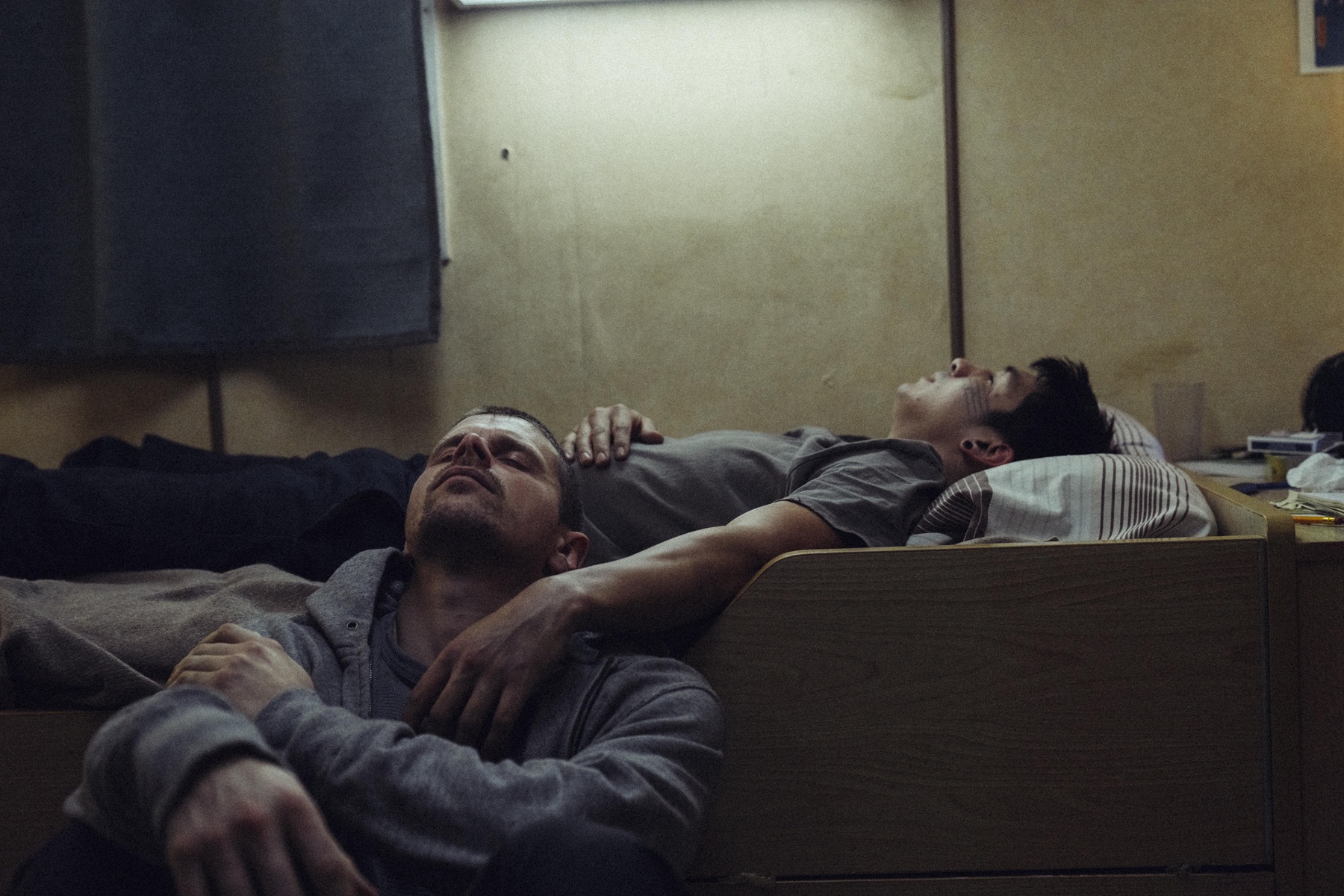
A murder aboard an isolated cargo ship becomes the starting point for a much deeper investigation in Rodrigue Jean’s Labrador – Autopsy of Silence. Set during the vessel’s final seasonal supply run to northern Inuit communities, the Canadian thriller follows Alupa Tulugak (Christopher Angatookalook), an Inuk mechanic who becomes the central suspect after the ship’s cook, Alex (Alexandre Landry), is found dead.
Their secret relationship complicates the investigation, while the ship’s rigid hierarchy raises questions about sexuality, authority, and whose version of events will be believed.
The film earned three awards at the 2026 Tribeca Festival, including Best International Narrative Feature and Best Performance in an International Narrative Feature for Angatookalook.
With distribution plans pointing toward a Canadian theatrical release in winter 2027, Labrador merits attention not simply as a murder mystery, but as a study of how power and silence shape the search for truth.
A Mystery Told Backward: Narrative Structure and the Problem of Evidence
Rather than following a conventional investigative trajectory, Labrador – Autopsy of Silence unfolds in reverse chronology, moving from the investigation toward the events surrounding Alex’s death. This structural choice changes the nature of the mystery. Instead of concentrating exclusively on the identity of the killer, the film invites viewers to reconsider the relationships, decisions, and unequal power dynamics that preceded the murder.
Each backward step offers another piece of context, complicating the audience’s understanding of Alupa and the circumstances that have made him a suspect. Information that might ordinarily resolve a mystery instead raises new questions about motive, responsibility, and the reliability of appearances. The investigation becomes as much a test of interpretation as a search for evidence.
The film’s use of French, English, and Inuktitut adds another dimension to this uncertainty. Language can shape who communicates comfortably, who must navigate cultural or linguistic barriers, and whose perspective receives attention. Within this framework, silence is not necessarily an absence of information. It can also suggest privacy, fear, or self-preservation, leaving viewers to consider what remains unspoken, and why.
The Cargo Ship as a Site of Power
The cargo ship in Labrador – Autopsy of Silence is more than an atmospheric backdrop. Its isolation and rigid professional hierarchy create an environment in which private relationships become entangled with questions of authority and responsibility.
Far from shore, the crew must continue working within the same confined space, even as personal tensions and the investigation surrounding Alex’s death threaten to disrupt the ship’s established order.
These tensions are particularly evident in the relationship between Alex and First Officer Michelle Comeau (Gabrielle Poulin B.). Michelle’s superior position gives her institutional authority over a subordinate, complicating the boundaries between professional obligation and sexual vulnerability.
Their dynamic invites viewers to consider how consent operates when one person holds substantially more power than the other. What might initially resemble an intimate conflict therefore becomes part of a broader examination of workplace hierarchy and the consequences of exploiting authority.
Alupa occupies a different position within this structure. As an Inuk mechanic who becomes the central suspect, he must navigate both the investigation and the assumptions surrounding his relationship with the murdered cook. His position invites questions about credibility: whose account is trusted, whose behaviour attracts suspicion, and how much institutional status influences the interpretation of evidence.
Read through this lens, the ship becomes a setting in which power shapes not only relationships but also the search for truth. The film’s critique of institutional authority and settler-colonial inequality emerges through the unequal positions of its characters.
Rather than offering a universal statement about Canadian institutions, Labrador directs attention to how authority operates in a particular environment, and how easily the pursuit of justice can become entangled with existing power imbalances.
Christopher Angatookalook and the Film’s Craft
At the centre of Labrador – Autopsy of Silence is Christopher Angatookalook’s portrayal of Alupa Tulugak, a character whose guarded presence becomes increasingly significant as the story moves backward.
Angatookalook received the Best Performance in an International Narrative Feature award at the 2026 Tribeca Festival, recognition that placed his work among the film’s most celebrated achievements.
His background in physical circus performance also provides an interesting point of context for considering how he uses movement, posture, and physical restraint to communicate emotion. Rather than relying solely on dialogue, the performance invites viewers to look for meaning in Alupa’s reactions and silences.
The film’s visual approach reinforces this sense of emotional confinement. Cinematographer Mathieu Laverdière, who also received a Tribeca award, captures the contrast between the ship’s enclosed industrial spaces and the vast, unforgiving maritime environment surrounding it.
The freighter’s metallic interiors create a feeling of restriction, while the open sea offers little reassurance or escape. This contrast reflects the tension between the characters’ private lives and the institutional structures governing their behaviour.
Sound further contributes to the atmosphere. The credited sound team includes Martyne Morin, Ilyaa Ghafouri, and Luc Boudrias, while Radwan Ghazi Moumneh composed the original score. Together, the film’s visual and sonic elements support its restrained approach to suspense, making isolation and uncertainty integral to the viewing experience.
Rodrigue Jean’s Filmography and the Politics of Place
Labrador – Autopsy of Silence can be read alongside Rodrigue Jean’s earlier films, which explore characters navigating difficult social circumstances and complicated forms of intimacy. His filmography includes Full Blast (1999), Yellowknife (2001), Love in the Time of Civil War (2014), and The Acrobat (2020). Although these works differ in setting and subject, they provide a broader context for examining Jean’s interest in lives shaped by marginalization, desire, and social precarity.
In Labrador, Jean shifts the focus to an isolated cargo ship serving northern Inuit communities. The setting introduces a distinct geographical and cultural context, placing an Inuk protagonist within a tightly controlled workplace where professional rank, personal relationships, and institutional authority intersect. The northern maritime environment is therefore more than a backdrop: it helps establish the physical isolation in which these conflicts unfold.
The film’s engagement with power and marginalization also invites consideration of how Jean approaches characters whose experiences do not fit comfortably within dominant social expectations.
Yet its significance lies not simply in extending themes from his earlier work. By combining a reverse-chronology mystery with questions of sexuality, Indigenous representation, and authority, Labrador offers a particular perspective on the relationship between individual vulnerability and larger social structures. Its place within Jean’s filmography is best understood through these continuities and differences, rather than as an assumed departure from his established concerns.
Tribeca Recognition, Early Reviews, and Distribution
The reception of Labrador – Autopsy of Silence at the 2026 Tribeca Festival gave Rodrigue Jean’s film significant international visibility. It received three awards: Best International Narrative Feature, Best Performance in an International Narrative Feature for Christopher Angatookalook, and Best Cinematography in an International Narrative Feature for Mathieu Laverdière.
The recognition highlights the film’s narrative ambition, central performance, and visual craft, while the jury’s published comments offer additional context for understanding its appeal.
Early critical responses have also been favourable. Nikki Baughan’s review emphasizes the film’s slow-burning, character-driven approach, while Jason Adams of Pajiba describes it as “a small marvel of a movie.”
Together, these assessments point toward a film whose emotional impact depends less on conventional thriller momentum than on atmosphere, performance, and the gradual accumulation of context. However, the relatively limited number of published reviews makes it premature to describe the response as a universal critical consensus.
The film’s distribution prospects provide another reason to follow its progress. H264 Distribution reportedly sold U.S. and U.K. rights to TLA Releasing, while a Canadian theatrical release is currently planned for winter 2027.
That window remains a plan rather than a confirmed release date. The combination of festival recognition and reported distribution activity gives Labrador a promising path toward a wider audience, although its eventual commercial reach remains to be seen.
Wrapping Up
In Labrador – Autopsy of Silence, the mystery surrounding Alex’s death ultimately opens onto questions that extend beyond the identity of a killer. Through its reverse chronology, confined maritime setting, and complicated relationships, Rodrigue Jean’s film examines how desire, institutional authority, and unequal power shape the way people are judged. Christopher Angatookalook’s award-winning performance anchors that exploration in Alupa’s struggle to navigate suspicion and personal vulnerability.
The film’s achievement lies in bringing these concerns into a thriller framework without reducing them to a straightforward question of guilt or innocence. Its gradual reconstruction of events encourages viewers to reconsider not only what happened, but also whose perspective has been heard and what circumstances remain hidden.
By bringing queer intimacy and institutional critique into its northern maritime setting, Labrador – Autopsy of Silence offers a distinctive contribution to contemporary Canadian cinema. Its most unsettling question may be not simply who is responsible for a death, but whose version of the truth ultimately prevails.