


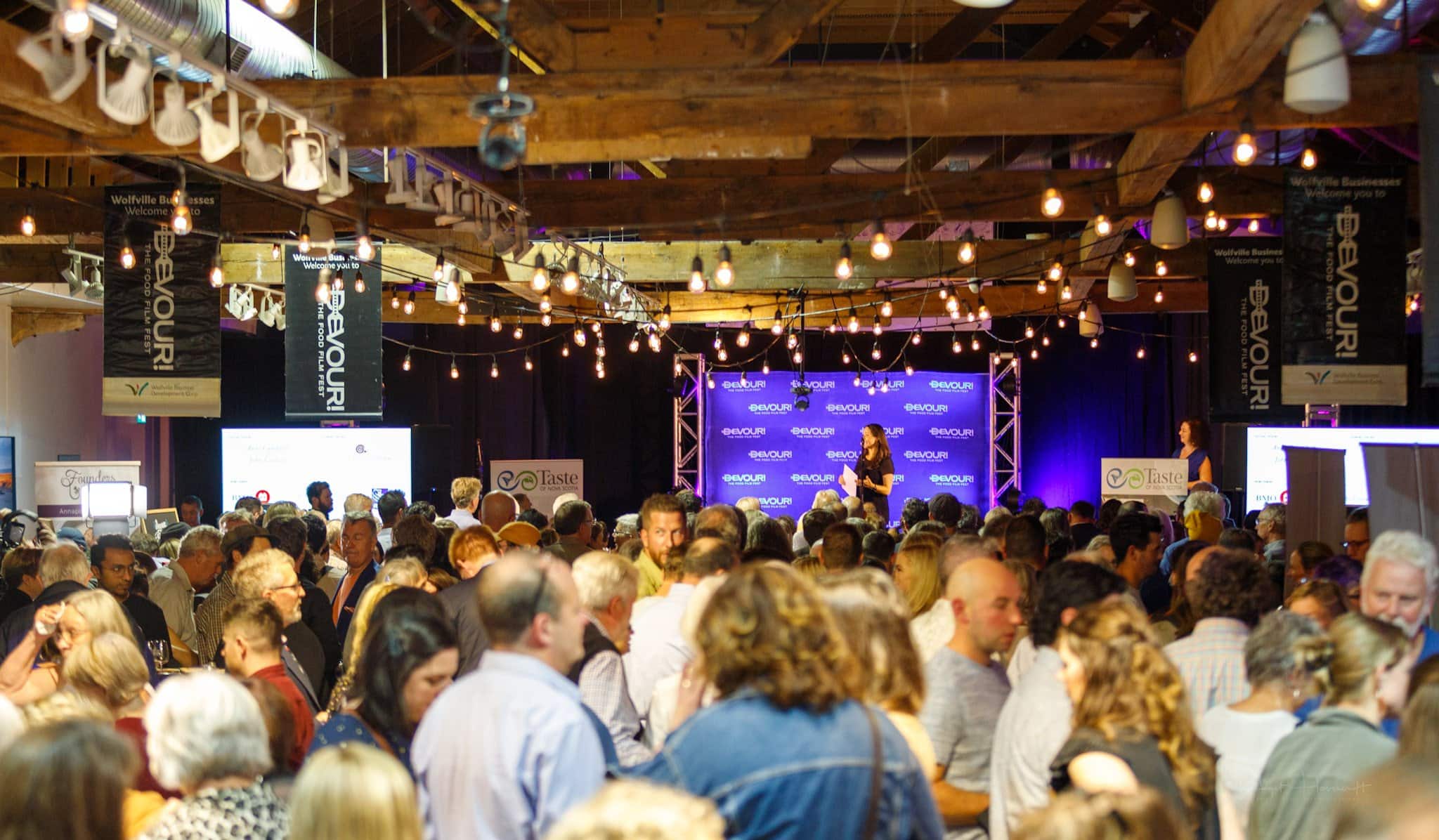
Few festivals manage to dissolve the boundary between cinema and cuisine as completely as Devour! The Food Film Fest. Held each year in Wolfville, Nova Scotia, the event returns for its 16th anniversary edition from October 19 – 25, 2026, reaffirming its status as the world’s largest festival dedicated to food on screen.
Rooted in the philosophy of Slow Food International, Devour! approaches food not simply as subject matter, but as culture, memory, and systems of meaning. Its guiding idea is deceptively simple: the way we eat reflects the way we live, and by understanding food more deeply, we can better understand the world around us.
Each edition brings together filmmakers, chefs, farmers, and audiences for a week-long program that transforms a quiet town in Nova Scotia into a global crossroads of culinary and cinematic exchange. It is part film festival, part food summit, and part communal experiment in how stories are told, and tasted, together.
What Makes Devour! Different
Unlike traditional film festivals that treat food as an add-on to screenings or hospitality events, Devour! builds its entire identity around the relationship between what we watch and what we eat. Here, cinema is not passive viewing; it is an entry point into larger questions about sustainability, agriculture, equity, and cultural memory.
Films are carefully curated not just for artistic merit, but for their ability to spark dialogue. A documentary on industrial farming might be followed by a chef-led dinner exploring local ingredients; a personal story about food heritage might lead into a community conversation about preservation and identity.
The result is a festival that operates less like a schedule of events and more like an unfolding ecosystem. Ideas move fluidly between screen, kitchen, and community space, blurring the boundaries between observer and participant.
At its core, Devour! is not asking audiences to consume content; it is asking them to reconsider consumption itself.
Signature Experiences That Define the Festival
If Devour! has a heartbeat, it is found in its tightly interwoven program of screenings and culinary events. Each element is designed to echo, respond to, or extend the others, creating a rhythm that carries throughout the week.
More than 50 films are typically presented across venues in Wolfville, most notably the historic Al Whittle Theatre. These selections span documentary, narrative, and experimental forms, but share a common thread: food as a lens for understanding human experience.
Some explore global supply chains and environmental pressures, while others focus on intimate personal stories, family recipes, cultural inheritance, or the emotional language of cooking.
But what distinguishes Devour! is what happens after the lights come up.
Chef-driven events form a parallel narrative. The Chefs and Shorts Gala pairs short films with multi-course dishes designed in direct response to the themes on screen, turning interpretation into something edible. Celebrity Chef Dinners bring internationally recognized culinary figures into close, conversational settings where the distance between creator and audience nearly disappears.
At the more playful end of the spectrum, events like Bourbon Brunches and the Chowder Smackdown introduce competition, humour, and regional pride into the mix. These aren’t side attractions; they are essential to the festival’s texture, reinforcing the idea that food culture is both serious and celebratory.
Community remains central throughout. Large-scale gatherings such as the Devour! Chicken Community Supper are designed not only as shared meals, but as acts of collective contribution, often supporting regional food banks and local food security initiatives. In these moments, the festival extends beyond cultural programming into civic engagement.
Beyond the formal events, Devour! encourages exploration of its surrounding landscape. Farm tours, foraging walks, culinary workshops, and regional excursions invite participants to engage directly with Nova Scotia’s agricultural environment. These experiences ground the festival in place, reminding attendees that food systems are not abstract; they are local, visible, and lived.
The Vision Behind Devour!
Behind the festival’s layered programming is a leadership team that bridges two distinct but deeply connected worlds: culinary arts and film culture.
Executive Director Michael Howell is a chef by training and a long-time advocate for food literacy and sustainable food systems. Before founding Devour!, Howell built a respected culinary career across Canada and abroad, including running the award-winning Tempest restaurant in Wolfville and cooking at the prestigious James Beard House in New York. His work has consistently centred on the belief that food is not only nourishment, but a form of cultural education.
Alongside him is Managing Director Lia Rinaldo, whose background in film programming and festival development spans more than three decades. Having worked extensively with major film institutions in Atlantic Canada, Rinaldo brings a curatorial sensibility that shapes how stories are selected, structured, and experienced. Her work ensures that Devour!’s cinematic programming is not separate from its culinary identity, but deeply integrated into it.
Together, Howell and Rinaldo have built a festival that does not treat film and food as parallel attractions, but as interconnected languages. One speaks through image and narrative; the other through taste and presence.
Wolfville: A Setting That Shapes the Experience
Devour!’s identity is inseparable from its location. Wolfville, situated in Nova Scotia’s Annapolis Valley, is a region defined by agriculture, vineyards, and a strong tradition of local food production. This is not a backdrop chosen for convenience; it is a landscape that actively informs the festival’s philosophy.
The surrounding farms and wineries are not simply sources of ingredients; they are part of the cultural fabric that Devour! engages with throughout its programming. Conversations about food systems gain immediacy when they are happening in a region where those systems are visible in everyday life.
The nearby UNESCO-listed Grand Pré landscape adds another layer of depth, connecting contemporary discussions about food and sustainability to centuries of agricultural history and human settlement. In this context, Devour! feels less like a temporary cultural event and more like an extension of place.
Just an hour from Halifax, Wolfville offers a rare balance: small enough to feel intimate, yet connected enough to host an international gathering of chefs, filmmakers, and audiences from around the world. That tension between local and global is part of what gives the festival its distinct character.
A Festival With Growing Global Reach
From its early editions to its current scale, Devour! has steadily expanded its influence within both culinary and film communities. It has attracted coverage from international publications including The Hollywood Reporter, Screen International, and USA Today, positioning it firmly within global conversations about food culture and cinematic storytelling.
Its growth has also been supported by strong institutional partnerships, including Telefilm Canada, CBC as a media partner, and the Atlantic Canada Opportunities Agency. These relationships reflect not only the festival’s cultural relevance, but its role within Canada’s broader creative and tourism ecosystems.
Over time, Devour! has become a destination for celebrated chefs and filmmakers. Figures such as Anthony Bourdain, Jacques Pépin, Phil Rosenthal, Dominique Crenn, and Bill Pullman have all been associated with the festival in various capacities, reinforcing its reputation as a gathering point for influential voices in food and film.
Yet despite this growing visibility, the festival has maintained a deliberate sense of scale. Rather than chasing expansion for its own sake, Devour! continues to prioritize intimacy, interaction, and shared experience.
Wrapping Up
Devour! The Food Film Fest stands apart because it treats food and film not as separate disciplines, but as complementary ways of understanding the world. It is a festival where ideas are not only presented, but prepared, served, and shared.
In Wolfville, that philosophy becomes tangible. A documentary screening might lead directly into a conversation over locally sourced dishes. A chef’s interpretation of a film might reshape how audiences think about what they’ve just seen. And a community meal might become the most memorable “screening” of all.
As Devour! continues to evolve, it remains grounded in a simple but powerful premise: storytelling is not confined to the screen, and food is never just food. Together, they form a language that is both universal and deeply human, one that Devour! continues to refine, one festival at a time.