


For years, audience development in Canadian entertainment followed a familiar pattern: release the project, promote it across a few channels, and hope it finds its audience. That “post-and-pray” approach was never ideal, but in 2026, it is no longer commercially sustainable.
In the wake of the Online Streaming Act (Bill C-11), discoverability has become more than a marketing concern; it is now a business imperative. As the CRTC continues shaping rules around prominence, reporting, and platform contributions, producers face growing pressure to prove that Canadian stories are not only being made, but actually being found and watched.
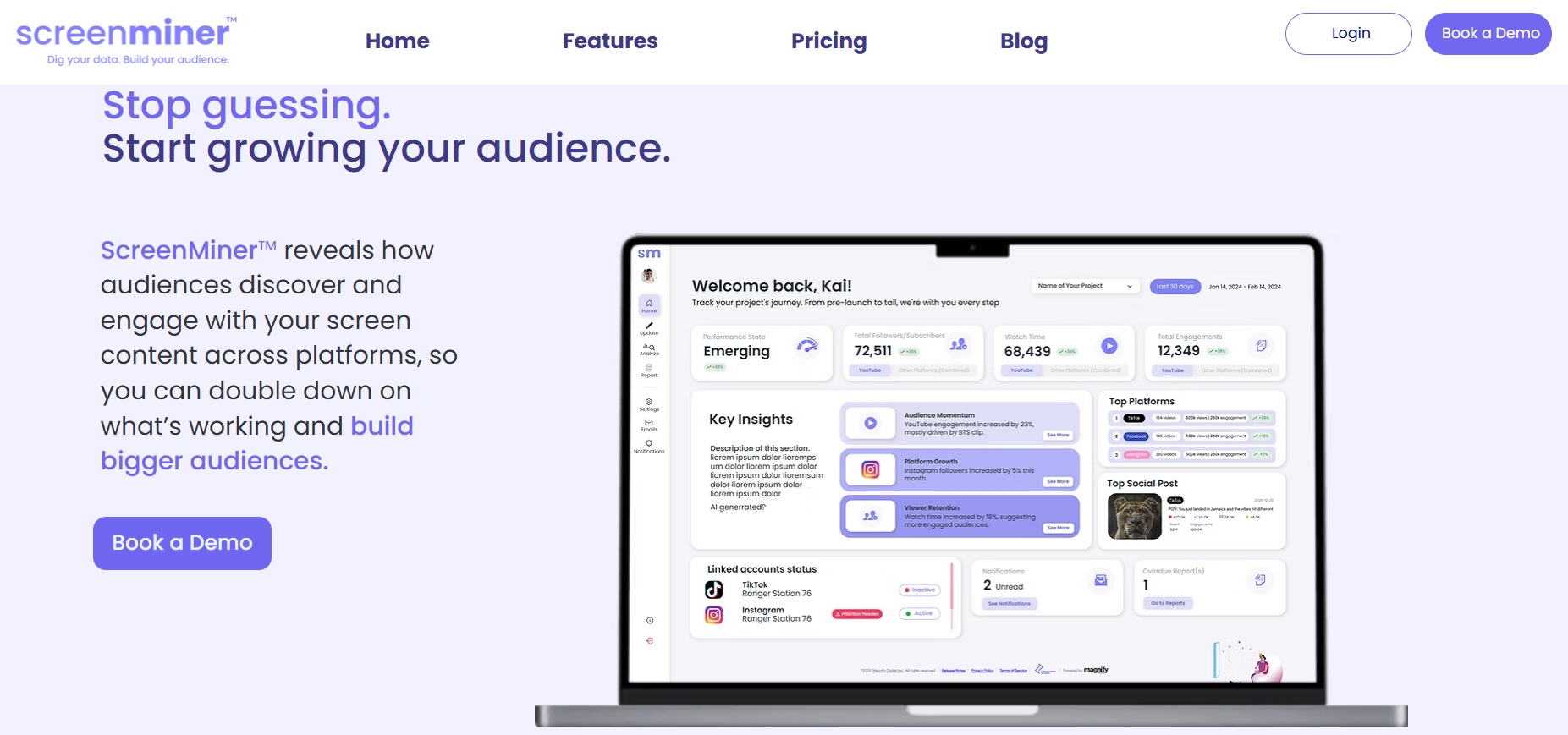
The challenge is that audience data remains fragmented across social platforms, websites, paid campaigns, and limited streamer reports. This is where ScreenMiner has become increasingly valuable.
Developed by Magnify Digital, it helps producers consolidate audience signals, track momentum, and make smarter decisions, turning audience strategy from an afterthought into a foundation for long-term success.
From Supply to Demand – The AI-Driven Pivot
For decades, Canada’s screen industry has been built on a strong production-first model. Public funders like the Canada Media Fund and Telefilm Canada have played a critical role in ensuring Canadian stories get made, supporting everything from early development to final delivery.
The emphasis was, understandably, on supply: financing projects, strengthening domestic production capacity, and protecting cultural output in a market heavily influenced by larger foreign players.
That foundation remains essential, but the conversation has shifted. These days, success is no longer measured only by whether a project gets produced; it is increasingly judged by whether it reaches an audience and sustains one.
Funding bodies, broadcasters, and distribution partners are placing greater weight on engagement, discoverability, and measurable audience performance. The question is no longer just “Can this be made?” but “Can this be found, watched, and remembered?”
This shift has exposed the limitations of relying on generic analytics tools alone. Platforms like Google Analytics, Meta dashboards, or Hootsuite can provide useful information, but they were not designed for the realities of film and television distribution.
They track clicks, impressions, and traffic patterns, but they rarely reflect how audiences actually move through a release cycle: how festival buzz influences discovery, how short-form clips drive interest before launch, or how a documentary performs differently from a scripted series.
ScreenMiner was built to fill that gap. Its approach is shaped around the logic of screen content rather than traditional digital marketing. Instead of treating a film like a product launch or a series like a standard ad campaign, it organizes information around release windows, genre behavior, platform-specific video engagement, and audience pathways that are unique to entertainment.
One of its biggest advantages is the ability to identify momentum earlier. A sudden spike in engagement around a trailer clip, stronger-than-expected performance from a cast interview, or unusual audience growth around a festival screening can all signal where attention is building before a major release push begins.
No platform can predict success with certainty, and incomplete APIs still create blind spots, but having early signals is far more valuable than discovering missed opportunities months later in a final report.
For producers working with limited marketing budgets, that difference matters. Instead of waiting until a campaign ends to understand what worked, they can adjust in real time, shifting spend toward the strongest-performing channels, refining creative assets, or changing release priorities while momentum is still building.
In a business where timing can shape everything, better visibility turns audience strategy from guesswork into a competitive advantage.
The Four Pillars of Strategic Advantage
The real value of ScreenMiner is not simply in gathering more data. Most producers already have access to plenty of numbers, i.e., views, clicks, impressions, watch time, ticket sales, or newsletter opens. The problem has rarely been a lack of information. It has been the difficulty of turning fragmented signals into decisions that actually improve audience outcomes.
ScreenMiner addresses that gap by giving producers a more usable framework for understanding performance. Its advantage can be understood through four core functions: aggregation, benchmarking, impact measurement, and portfolio visibility.
The first is aggregation and contextualization. Audience behavior rarely happens in one place. A trailer may gain traction on YouTube, a cast interview may perform unexpectedly well on TikTok, festival coverage may drive search traffic, while paid campaigns influence newsletter signups and website visits.
Looking at those channels separately often creates false conclusions. ScreenMiner pulls data from social platforms, web analytics, paid advertising systems, and manually reported distributor or streamer insights into one place, allowing producers to see how those signals connect. More importantly, it frames those numbers through a screen-industry lens rather than treating them like generic marketing metrics.
The second pillar is benchmarking and sector intelligence. One of the most common challenges for producers is knowing whether a campaign is actually underperforming or simply behaving normally for its category.
A documentary release will not follow the same audience pattern as a children’s series or a scripted drama. Without comparison points, teams often make reactive decisions based on incomplete assumptions.
ScreenMiner helps solve that by comparing performance against anonymized, genre-specific industry patterns. This creates a more realistic standard for evaluating success and identifying opportunities for improvement.
The third pillar moves beyond reach and visibility into something much harder to define: cultural impact. In Canadian entertainment, success is not measured only by raw audience volume. Recognition matters too: critical response, festival presence, awards attention, media coverage, and the broader conversation a project creates.
Through its research collaboration with OCAD University, supported by TELUS Fund, ScreenMiner contributes to developing stronger methods for measuring these less tangible outcomes, including cultural relevance, audience resonance, and long-term sector impact. This is especially valuable for projects where long-term cultural relevance may matter as much as immediate commercial return.
The fourth advantage is portfolio-level visibility. For production companies managing multiple titles across a year, audience strategy cannot happen one project at a time. Leadership needs to understand which release approaches consistently perform best, which campaign structures produce stronger ROI, and where resources should be concentrated across the slate.
ScreenMiner offers that wider perspective. Instead of isolated postmortems, producers gain a clearer understanding of patterns across projects, helping them make stronger decisions at the company level.
Taken together, these four functions position ScreenMiner as more than reporting software. It becomes a strategic layer between audience behavior and executive decision-making; something increasingly necessary in a market where proving momentum matters almost as much as creating the content itself.
The New Gold Standard for Funding and Accountability
The shift toward stronger audience intelligence is not happening in isolation. It reflects a broader change in how success is being measured across Canada’s funding ecosystem.
Producers are no longer expected to simply complete a project and submit a final report. Increasingly, they are expected to demonstrate that the work reached people and that those results can be measured.
The Canada Media Fund’s 2026–2027 Broadcaster Envelope model makes this shift especially clear. Audience Success, measured through total hours tuned, now carries significant weight in envelope calculations, 35 percent for the English stream and 40 percent for the French stream. That is a major signal.
While regional production, diverse ownership, and historical participation remain important, audience performance is now firmly part of how funding decisions are shaped.
This reflects a larger reality across the industry: demand matters. Funders want stronger evidence that supported content is connecting with audiences in meaningful ways, not simply existing within the system. For producers, that means audience development can no longer be treated as a final-stage marketing task. It must be built into strategy much earlier.
Telefilm Canada has also moved toward stronger reporting expectations around marketing effectiveness and audience reach. The emphasis is increasingly on outcomes rather than activity alone.
It is no longer enough to show that campaigns were launched or promotional spend was allocated. Producers need to explain what happened as a result: what channels performed, where engagement grew, and how audience momentum translated into measurable impact.
This is where ScreenMiner becomes especially valuable. By consolidating performance data across campaigns, platforms, and release stages, it creates reporting structures that are far more useful for both internal decision-making and external accountability.
Instead of assembling fragmented spreadsheets and screenshots from multiple platforms, teams can present a clearer, more audit-friendly picture of audience development.
For mid-sized independent producers, this can be a major advantage. Stronger audience intelligence improves not only funding applications, but also conversations with distributors, broadcasters, and international co-production partners.
Demonstrating real audience traction, whether through engagement patterns, campaign performance, or sustained interest, creates leverage. It gives producers something concrete to bring to the table, especially when negotiating in an environment where the largest platforms still control much of the most valuable viewing data.
In that sense, audience intelligence is no longer just a reporting tool. It is becoming part of financial strategy, institutional trust, and competitive positioning. The producers who understand that shift earliest will be the ones best positioned to thrive within it.
Future-Proofing: From Discovery to Retention
Much of the conversation around Bill C-11 has centered on discoverability: how Canadian content appears, how platforms promote it, and whether audiences are given meaningful opportunities to find it. That conversation matters, but discoverability alone has never been enough.
Being surfaced by a platform is only the first step. Visibility creates possibility, not loyalty. A title can be recommended, featured, or pushed into prominence and still fail to build a lasting audience connection. The real challenge is discovery in the deeper sense: not simply being seen, but being chosen, remembered, and returned to.
This is where the distinction between discoverability and discovery becomes important. Discoverability is the platform “push.” Discovery is the audience “pull.” One is largely influenced by regulation and platform behavior; the other depends on whether the work resonates strongly enough for audiences to keep engaging after the first click.
ScreenMiner helps producers operate in that second space. Instead of focusing only on launch visibility, it supports a longer view of audience behavior, tracking how engagement evolves over time, where retention is strongest, and which channels continue driving meaningful interest after the initial campaign ends.
Repeat viewing patterns, sustained social conversation, newsletter engagement, and community response all offer stronger indicators of long-term value than a temporary spike in impressions.
This matters even more in a constrained financial environment. Marketing budgets across the Canadian screen sector remain tight, and customer acquisition costs continue to rise.
Producers cannot afford to spread resources evenly across every platform and hope something sticks. Data-informed decision-making allows teams to invest more confidently in channels and formats that consistently convert attention into sustained audience relationships.
The result is not simply better efficiency; it is greater sustainability. Lower acquisition costs, stronger retention, and clearer evidence of audience loyalty make future releases easier to support and easier to finance. Audience trust compounds over time.
There is also a broader ecosystem opportunity here. Regional and provincial organizations such as Creative BC and SODEC are increasingly positioned to support data literacy alongside production funding. Access to audience intelligence should not be limited to the largest companies with the biggest marketing budgets.
Helping producers across the country build stronger measurement practices strengthens the entire sector.
The long-term goal is not just better discoverability. It is a healthier relationship between Canadian creators and the audiences they serve; one built on understanding, continuity, and strategic ownership rather than dependence on opaque global platforms.
Wrapping Up
For a long time, Canadian creators have been asked to compete in a global entertainment market while operating with only partial visibility into how audiences actually behave. Distribution platforms controlled the data, funders focused primarily on output, and producers were often left trying to prove success after the fact.
That model is changing.
Audience intelligence is becoming a core part of how projects are developed, marketed, funded, and sustained. Tools like ScreenMiner do not replace strong storytelling, smart distribution, or meaningful audience relationships, but they make those efforts far more measurable and far more strategic.
The real benefit is not just better reporting. It is ownership. When producers understand where momentum is building, what drives retention, and how audiences engage over time, they gain more control over the future of their work.
In an increasingly competitive international market, Canadian stories need more than visibility; they need durability. Better audience intelligence helps build that foundation.
For producers looking to strengthen audience strategy, supported access to platforms like ScreenMiner, alongside broader industry efforts around data literacy and discoverability, may prove to be one of the most important long-term investments they make.
This is make such an articulate case for screen media analytics, it makes one wonder why it has taken so long for the film sector to wake up and take this discipline more seriously in practice. How is it possible to even think of financing the supply of film media without first taking into account the audiences that will consume it? Can you imagine if companies like Proctor and Gamble thought like this – pushing product into the market without carefully considering who and where such products would be consumed? Audience analytics deserves to become fulling baked into screen media production and financing budgets. It is superb that a vendor like ScreenMiner is make this kind of audience analytics available to bring audience accountability to this business.