
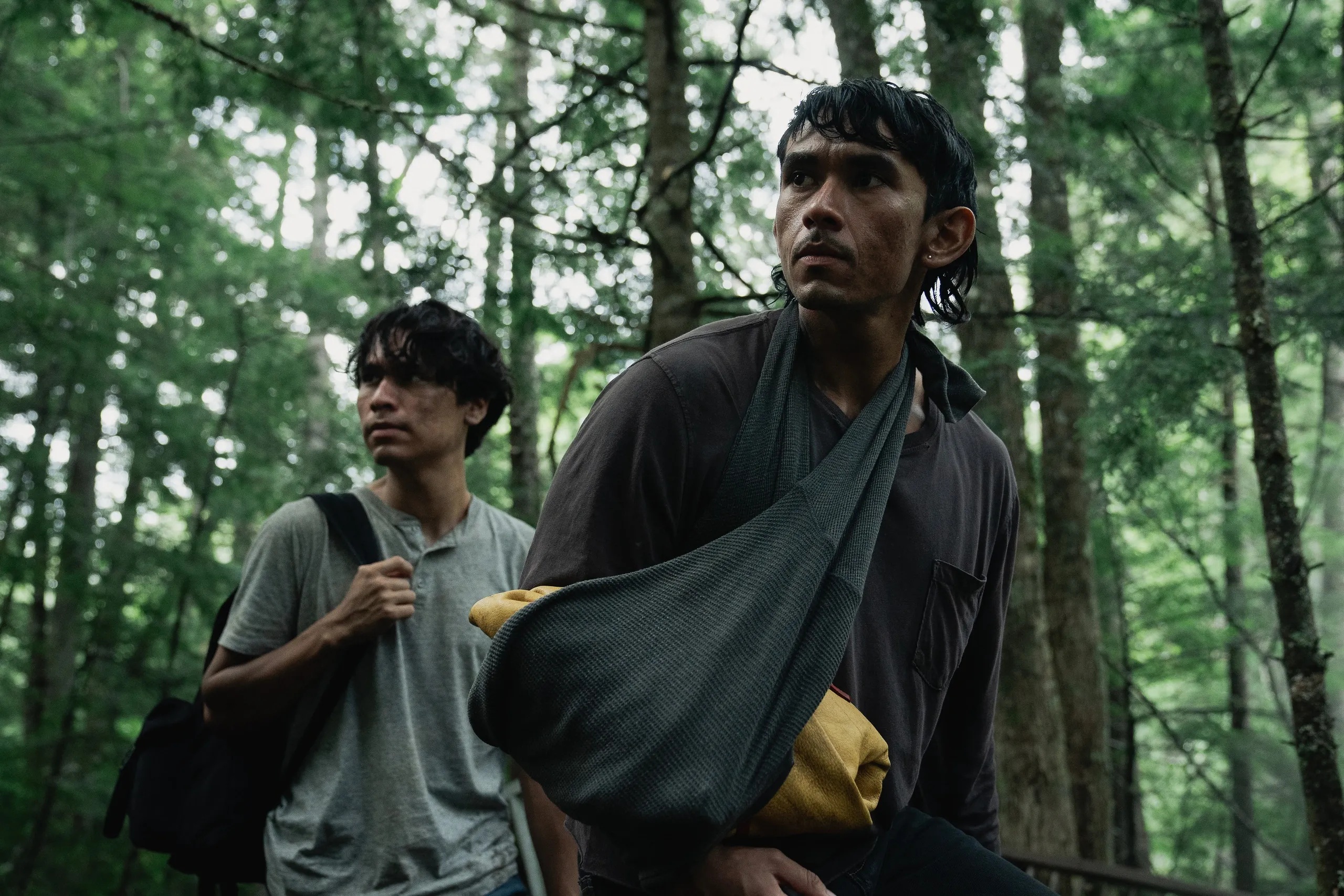
Bretten Hannam’s At the Place of Ghosts is set to reach Canadian theatres this March, following a festival run that quietly positioned the film as one of the more distinctive Indigenous genre works of the past year.
Blending elements of psychological horror, family drama, and spiritual reckoning, the film continues Hannam’s ongoing exploration of Mi’kmaw identity, trauma, and the enduring relationship between people and land.
Also known by its Mi’kmaq title Sk+te’kmujue’katik, the film follows two estranged brothers who reunite after being haunted by a malevolent presence rooted in their shared childhood.
Premiering at the 2025 Toronto International Film Festival and opening the Atlantic International Film Festival shortly after, At the Place of Ghosts arrives in cinemas on March 6, 2026, carrying with it both critical attention and a growing sense of anticipation.
About the Film
At the Place of Ghosts (Sk+te’kmujue’katik) is a Canadian thriller that centres on Mi’kmaw brothers Mise’l and Antle, played by Blake Alec Miranda and Forrest Goodluck. Once close, the two have grown apart in adulthood, their relationship fractured by a traumatic childhood and years of unspoken guilt. When Mise’l is visited by a malevolent spirit, its reappearance forces the brothers to reunite and return to the land they left behind.
Their journey leads them into Sk+te’kmujue’katik, the Place of Ghosts, an ancient forest where time feels unstable and the past refuses to remain buried. As the brothers move deeper into the wilderness, memories, spirits, and unresolved pain surface, blurring the line between the supernatural and the psychological.
Rather than relying on traditional horror mechanics, the film uses atmosphere, silence, and repetition to explore themes of intergenerational trauma, cultural memory, and the possibility of healing.
Written and directed by Bretten Hannam, the film continues the filmmaker’s interest in genre as a gateway into personal and communal stories. At the Place of Ghosts positions horror not as an end in itself, but as a vessel for examining identity, land, and the bonds that persist even after long estrangement.
Cast and Performances
At the centre of At the Place of Ghosts are performances that rely less on exposition and more on physical presence and emotional restraint.
Blake Alec Miranda and Forrest Goodluck anchor the film as Mise’l and Antle, brothers whose shared history weighs heavily on every interaction. Miranda plays Mise’l with a quiet unease, conveying a character who has distanced himself from home but remains deeply tethered to it, while Goodluck brings a grounded intensity to Antle, a man who stayed behind and carries responsibility in a different form.
Their chemistry feels lived-in rather than dramatic, shaped by pauses, glances, and moments of discomfort rather than overt confrontation. The dynamic allows the film’s themes of guilt, accountability, and reconciliation to unfold gradually, without forcing resolution.
Supporting performances further flesh out the emotional landscape. Glen Gould appears as the brothers’ father, a brief but impactful presence whose shadow looms large over the story.
Skylar Cope and Atuen MacIsaac portray the brothers in childhood, grounding the film’s flashbacks with a sense of vulnerability that deepens the weight of what follows. A wider ensemble, including Brandon Oakes and several community figures, reinforces the film’s focus on connection, memory, and collective experience.
Creative Team and Craft
Bretten Hannam writes and directs At the Place of Ghosts with a confident, restrained approach, using genre as a framework rather than a destination.
As with Wildhood, Hannam allows emotion, memory, and landscape to guide the narrative, trusting images and sound to carry as much weight as dialogue. The film’s non-linear structure mirrors its themes, treating time as fluid and trauma as something that resurfaces rather than recedes.
Cinematographer Guy Godfree’s work is central to the film’s impact. Shot in and around Nova Scotia, the forest becomes both a physical setting and a spiritual presence, captured in rich, natural textures that balance beauty with unease.
Long stretches of quiet observation are punctuated by unsettling visual details, reinforcing the sense that the land itself is bearing witness.
Equally integral is the score by Award–winning Indigenous musician Jeremy Dutcher, whose music moves between melancholy and menace. Blending natural sounds with choral and atmospheric elements, the score deepens the film’s emotional pull without overpowering it.
Editing by Shaun Rykiss and Anne-Laure Guégan maintains a deliberate, unhurried rhythm, allowing scenes to breathe and tension to accumulate slowly.
Together, these elements shape a film that leans into mood and reflection, inviting the viewer to experience the journey rather than rush toward its conclusion.
Reviews
Since its premiere at TIFF, At the Place of Ghosts has drawn thoughtful and often passionate responses from critics, with much of the discussion centring on its atmosphere, cultural specificity, and deliberate pacing.
Variety described the film as “a simple story with a lot on its mind,” noting how Bretten Hannam uses genre to explore Mi’kmaw relationships to land, memory, and intergenerational trauma, framing horror as an invitation to deeper reflection rather than spectacle.
At Screen Daily, Nikki Baughan called it “an atmospheric horror” buoyed by “unhurried pacing and strong performances,” highlighting its assured sense of identity and the way it stands out in a crowded genre field through cultural specificity and visual restraint.
Writing for Bloody Disgusting, Joe Lipsett emphasized the film’s visual storytelling and mood-driven structure, observing that it is “much more interested in the journey than the destination,” rewarding patient viewers with striking imagery and a contemplative emotional arc.
Next Best Picture praised the film’s genre-bending ambition and evocative imagery, while also noting moments of uneven pacing and underdeveloped supernatural elements. Still, the review highlighted the performances’ strength and the emotional weight of the brothers’ relationship as key anchors.
Responses were more mixed from outlets like Film Focus Online and Shade Studios, which admired the film’s cinematography, performances, and thematic intent but found the screenplay and pacing uneven. Both reviews pointed to a tension between the film’s heavy subject matter and its restrained narrative approach, particularly for viewers expecting a more conventional horror experience.
More enthusiastic praise came from The Varsity, which described the film as “an emotional masterpiece,” applauding its multilayered storytelling, immersive sound design, and decolonial approach to time, trauma, and healing through community.
Critical Consensus
Taken together, reviews position At the Place of Ghosts as a visually striking, emotionally grounded film that prioritizes atmosphere, memory, and cultural reflection over traditional horror mechanics.
Critics consistently praise its cinematography, score, and lead performances, as well as Hannam’s commitment to telling Indigenous stories through a genre lens. While its slow-burn pacing and abstract structure may test some viewers’ patience, the film has been widely recognized as a distinctive entry in contemporary Canadian cinema, one that rewards those willing to sit with its silences and shadows.
Festival Journey & Awards
At the Place of Ghosts began its public life on the festival circuit with a high-profile world premiere at the 2025 Toronto International Film Festival, screening in the Platform Prize program on September 6. The selection placed Bretten Hannam’s latest feature alongside some of the year’s most ambitious international cinema, introducing the film to audiences beyond Atlantic Canada.
Just days later, the film screened as the opening night selection at the 2025 Atlantic International Film Festival, a particularly fitting homecoming given its Nova Scotia setting and Mi’kmaw cultural roots.
The reception there translated into multiple honours, with At the Place of Ghosts winning the Gordon Parsons Award for Best Atlantic Canadian Feature. The film’s craft was also recognized, as cinematographer Guy Godfree received the Best Atlantic Cinematographer award, and Jeremy Dutcher was honoured with Best Atlantic Score for his haunting musical contribution.
The film’s festival run continued with its selection for the Borsos Competition at the 2025 Whistler Film Festival, further cementing its place as one of the standout Canadian features of the year.
Together, these screenings and awards underscore the film’s impact across both national and regional festival circuits, setting the stage for its Canadian theatrical release in March.
Why It Matters
At the Place of Ghosts arrives at a moment when Indigenous filmmakers in Canada are increasingly using genre to tell stories that resist easy categorization.
Rather than separating horror, drama, and cultural storytelling, Bretten Hannam folds them together, using the familiar language of the supernatural to explore ideas of memory, land, and responsibility.
The film also continues a growing conversation around how trauma is represented on screen. By treating time as non-linear and healing as a process rather than a resolution, At the Place of Ghosts challenges conventional narrative expectations.
It asks viewers to sit with discomfort, silence, and repetition, mirroring the ways personal and collective histories often resurface rather than disappear.
Beyond its thematic concerns, the film’s significance lies in its sense of place. Shot in Nova Scotia and grounded in Mi’kmaw culture, the forest is not merely a backdrop but an active presence, reinforcing the connection between people, ancestry, and land.
In doing so, At the Place of Ghosts adds to the evolving landscape of Canadian cinema, offering a film that is as much about listening and witnessing as it is about confrontation.
Release Information
At the Place of Ghosts will be released in Canadian theatres on March 6, 2026, distributed by VVS Films. The film runs 87 minutes and is primarily in English, with elements of Mi’kmaw and French woven throughout, reflecting its cultural and linguistic roots.
Audiences can expect a cinematic experience that balances psychological tension, family drama, and the haunting beauty of Nova Scotia’s landscapes, offering both an emotional journey and a reflection on memory, trauma, and healing.
Wrapping Up
With strong performances, evocative cinematography, and a score that amplifies both tension and reflection, the film marks another important step in Hannam’s ongoing exploration of Mi’kmaw culture and the complexities of intergenerational trauma. As it prepares for its Canadian release in March, At the Place of Ghosts is poised to resonate with audiences looking for a thoughtful, genre-infused experience that lingers in both heart and mind.