




A casting conversation can reveal a character the writer has not fully seen. An actor notices that a joke is defensive, a director imagines a slower physical rhythm, or a casting reference suggests a different age and social history. The danger begins when those useful interpretations quietly become facts the screenplay never established.
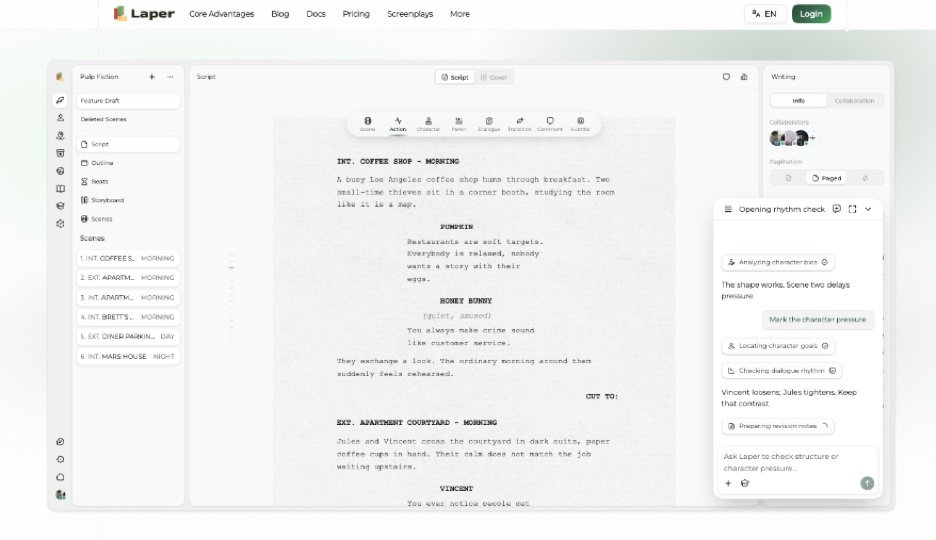
Good AI Screenwriting Software should help a film team compare the page, the profile and the casting lens without collapsing them. Laper creates shared character entities from screenplay cues and connects them to profiles, relationships and casting views. The screenplay still decides what the character says and does; the other views support interpretation and production.
Start With The Evidence On The Page
Before adding a casting idea, list what the script actually proves. A character arrives early, avoids eye contact with her brother, speaks precisely under pressure and pockets a broken watch. These are playable facts. “She is emotionally unavailable” is an interpretation. “She grew up in a military family” is new backstory unless the screenplay states or demonstrates it.
Labeling the difference does not make the casting process rigid. It gives an actor room to test interpretations without forcing every rehearsal discovery into the character biography.
Separate Page Facts Inferences And Performance Experiments
Use three simple categories. Facts are established by the current screenplay. Inferences explain those facts but remain contestable. Experiments are choices to try in a read or audition. An actor may experiment with the broken watch as a source of shame. If that makes the sibling scene clearer, the director can keep the performance choice without inventing a childhood event to justify it.
This distinction is especially useful for independent productions, where one strong audition can redirect a character quickly. The team can respond to the actor while still seeing which downstream scenes would need a deliberate rewrite.
Create a one-page evidence card for the audition scene. Put established actions on the left and open questions on the right. Do not include a polished biography unless the actor needs it to perform the selected pages. The gaps are useful: they give the room permission to discover possibilities instead of rewarding whoever most closely imitates an internal reference.

Use Casting References As Interpretive Lenses
A reference image or performer comparison should answer a production question. It may clarify age range, movement, comic timing, physical contrast or the energy between two roles. It should not become a shortcut for copying a known performance or assuming the character inherits another actor’s identity.
Laper’s character and casting views can collect references around the same entity that appears in the script. That proximity is helpful if the team preserves the boundary: the reference suggests how to look; the page shows what must be played.
Write The Casting Question In Neutral Terms
Instead of “find someone like this celebrity,” state the dramatic requirement. “Can the performer make the character’s careful politeness feel like control until the final interruption?” is testable in a read. It invites different bodies, voices and backgrounds to solve the same dramatic problem.
A neutral question also improves feedback. Reviewers can discuss whether the turn was visible rather than whether the performer matched a familiar image.
Apply the same discipline to chemistry reads. Define the relationship action that must become legible: one sibling needs the other’s approval but disguises the need as criticism. Then observe how different pairs create that imbalance. A strong pairing may solve the action through timing or distance that the original casting image never suggested.
Run The Audition Against One Scene Turn
Choose a short scene with a clear change in strategy. The character begins by managing the room through courtesy, loses control when the sibling names the watch, and chooses whether to leave or answer. The audition does not need to prove an entire biography. It needs to show that the performer can make the change readable without explanatory dialogue.
Record Notes At The Right Level
After the read, place each note where it belongs. “The pause before the answer clarified the lie” is a performance note. “The relationship needs a shared financial consequence” is a story diagnosis. “Add a line saying she stole the watch” is a proposed screenplay change. Keeping the levels distinct prevents an observation from becoming a rewrite by accident.
Close the session by reading the notes aloud in category order. Contradictory performance experiments can coexist; contradictory canon facts cannot. If one reviewer believes the character is protecting the brother and another believes she is controlling him, retain both as lenses until the page or next read provides stronger evidence.
An AI screenplay software workflow can help compare a selected scene with the approved profile and relationship notes. Ask for contradictions, not a replacement performance. The assistant may reveal that a new biography claims the siblings were estranged while three scenes show weekly contact. A human editor decides whether the profile or pages should change.
Photograph The Boundary Not The Performer
For a visual review, place the screenplay evidence card beside several abstract casting lenses and keep a visible divider between them. The image should show one source feeding many interpretations, not one face being chosen as the answer. That same mental model keeps exploratory material from hardening into canon.
Promote A Performance Discovery Into Canon Deliberately
Sometimes an actor’s choice exposes a better version of the character. Promote it in a controlled sequence. First state the discovery without biography. Then identify every scene it affects. Decide whether it remains a performance direction or requires new action and dialogue. Only after approval should the project profile or relationship model change.
- Describe the observed performance choice.
- Name the dramatic problem it solves.
- Trace contradictions across existing scenes.
- Approve the smallest screenplay change.
- Update supporting character material last.
The order matters. Updating the profile first can make speculative backstory look authoritative and pressure the script to follow it.
Protect The Character During Visual Development
Concept art, wardrobe boards and generated portraits can create a strong impression before casting is complete. Review those assets for narrative claims. A uniform may imply a profession, a scar may imply history, and a luxury apartment may imply resources the plot denies. Attractive images are not neutral.
Laper can associate visual assets with character entities and scenes, making those assumptions easier to find. It cannot confirm that an image respects the production’s cultural, accessibility or identity choices. Those reviews require the relevant people and lived knowledge.
Keep Rejected Directions Visible But Inactive
A rejected experiment may be useful later, but it should not remain mixed with approved references. Mark it inactive or store it outside the current set. The next collaborator should not have to guess whether the older image still describes the role.
Let The Actor Expand The Performance
The aim is not to keep actors inside a narrow diagram. It is to protect the difference between invention and evidence so a strong performance can challenge the draft honestly. When the team knows what the page establishes, it can recognize exactly where an interpretation opens a new possibility.
Laper provides a practical place to hold script, character and casting material together. The creative contract remains human: actors can propose, directors can test, and writers can decide when a discovery deserves to change the story.