


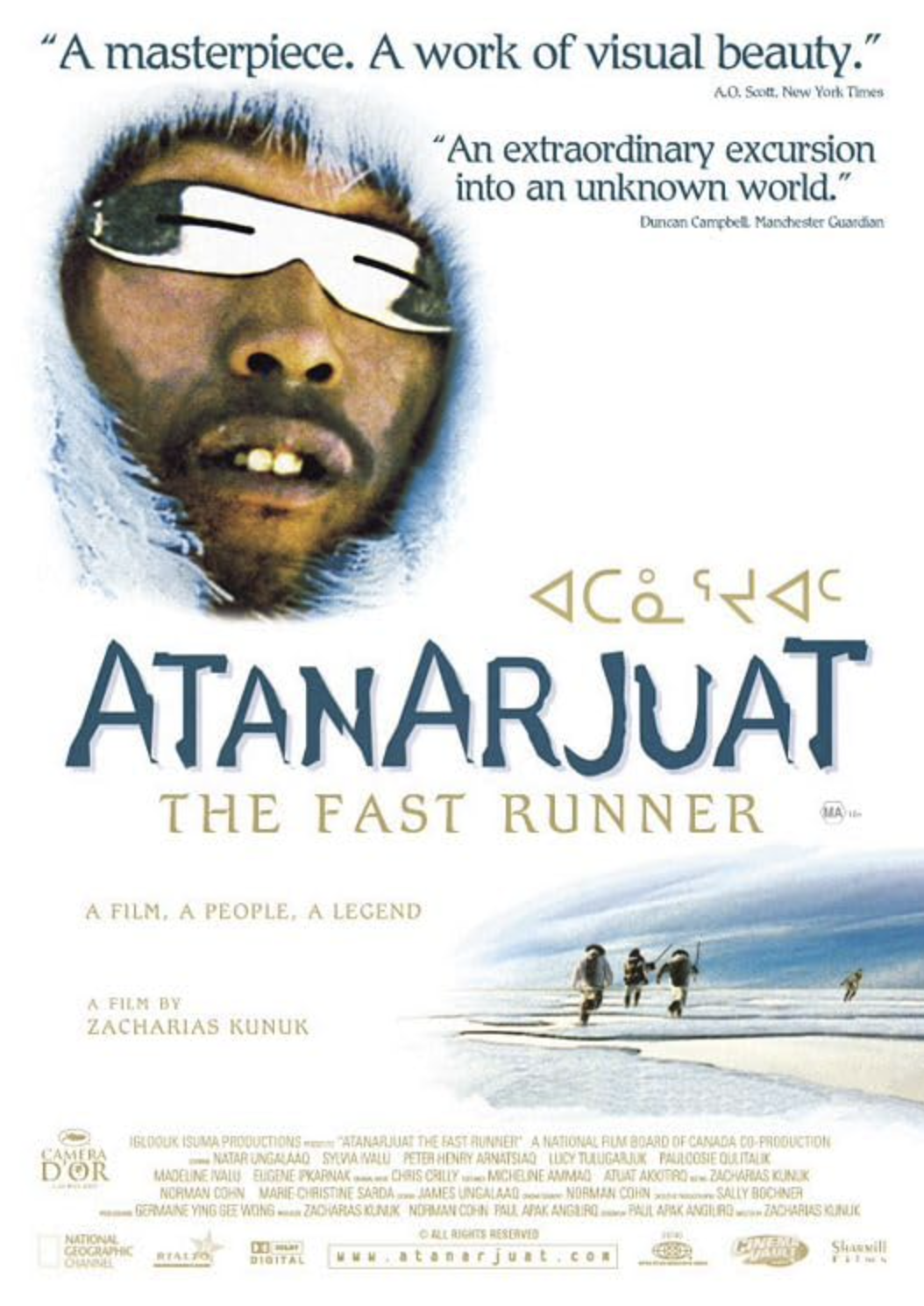
Minus thirty degrees. That’s roughly what the crew was working in when they filmed some of the most demanding scenes of Atanarjuat: The Fast Runner. Cameras stopped working. People are often surprised when they hear that last part. A film with no studio money, no famous names, and a script in a language most of the world had never heard spoken on screen – how did that end up competing at one of the biggest festivals on the planet? The answer has less to do with luck and more to do with what happens when a community finally gets full control over how its own history gets told.
Where the Story Actually Comes From
Long before anyone thought about cameras, Atanarjuat existed as something people said out loud. The plot centers on a man named Atanarjuat. His community falls apart because of jealousy and rivalry, stirred up by an evil spirit that disrupts everything around him. His only way out is to run – barefoot, with nothing on, straight across open ice – which became the single most talked – about image from the finished film.
Different elders in Igloolik carried slightly different versions, shaped by memory and by who was doing the telling. Before a script could exist, someone had to go around, sit with those elders one by one, and piece together a version everyone could agree captured the story properly.
Viewers wanting the full cast breakdown or a rundown of the film’s crew and production history can find that listed under Atanarjuat: The Fast Runner. It’s a reasonable place to start before getting into how a legend told by firelight ended up on a movie screen. Converting a spoken story into something filmable is trickier than people assume. None of that survives a direct translation onto paper. Writers had to hold onto what made the story land emotionally while reshaping it into scenes, dialogue, and structure – something a stranger watching for the first time could follow and feel.
Getting the Film Made at All
The people who made this film weren’t visitors studying a culture from outside. They lived it. Kunuk directed. He’d grown up in Igloolik and had years of video experience already behind him by the time this project started, which meant he understood the land, the people, and the story on a level an outsider couldn’t fake. Angilirq wrote the screenplay. He spent years – actual years, not months – talking to elders and gathering different threads of the legend before he had something he felt was ready to shoot. All of that happened before a single scene was filmed.
Convincing funders to back that idea took real persuasion. It meant arguing that a story could carry its emotional weight even for audiences who had no prior connection to Inuit history. Casting worked the same way. Rather than bringing in trained actors from outside Nunavut, the production used people from the community itself. That slowed everything down – rehearsals stretched longer, performances took more coaching – but it meant the people on screen actually understood the clothing, the tools, and the land they were representing. That sense of realism turned into one of the things critics kept coming back to once the film reached audiences outside the Arctic.
Filming on the Ice
Nearly all of the shoot happened outdoors. The crew set up near Igloolik and often had to wait, sometimes for days, for conditions to line up – enough daylight, stable ice, workable weather. Winter days that far north offer only a few usable hours of light, so the whole schedule had to bend around that instead of the other way around.
Standard film equipment isn’t built for that kind of cold. Cameras needed constant adjustment just to keep functioning. Batteries drained far faster than normal. At one point, cold temperatures thickened the lubricant inside camera gears enough to jam them mid-take. The crew adjusted by filming in short stretches, keeping backup gear warm whenever they could, and padding the schedule with extra time for repairs that nobody had planned for.
The physical toll on the cast matched the technical struggles behind the camera. The film’s central scene – Atanarjuat running naked and barefoot across the ice – was shot in real winter conditions, without visual effects or an indoor set standing in for the location. Safety measures were in place, but the sequence remains one of the more physically punishing scenes ever captured for a fictional film, largely because almost none of it was staged. There was also a constant push and pull between staying accurate and staying on schedule. Traditional clothing and tools had to be represented correctly, so the crew regularly checked in with community members and elders throughout filming.
What Happened at Cannes
Nobody involved had really expected that outcome, especially given how far the production had operated from any traditional film industry hub. Critics picked up on how different the film felt. Instead of observing Inuit life from a distance, it put viewers directly inside the community, moving at its own pace rather than a pace built for a general audience. Back home, the reaction meant something different entirely. For people in Igloolik and across Nunavut, watching their language and their land represented with this level of accuracy on an international stage carried weight no festival award could really measure. Younger viewers saw their culture handled with care instead of treated as scenery. Elders saw stories they’d told for decades reach people they’d never meet.
The win also changed what funders were willing to support. Organizations that might have hesitated to back an all-Inuktitut film now had proof the approach could succeed, both critically and financially. Isuma kept making Inuit – led films after that, and other Indigenous filmmakers pointed to Atanarjuat as evidence that stories like theirs could reach the same stages as anyone else’s.
Why the Film Still Gets Talked About
Atanarjuat holds a specific place in Canadian film history, separate from the award itself. Before this film, Inuit stories on screen were almost always told by people outside the culture, usually through a documentary style that treated Inuit life as something to observe rather than something lived. This film reversed that entirely.
A full – length film made entirely in it gave the language visibility it rarely received anywhere else. Schools and language preservation groups later pointed to the film as proof that a traditional language could hold up in a modern format without losing anything in the process. More than two decades on, people are still studying it, still screening it, still writing about it – not as a curiosity from a festival lineup, but as one of the clearest examples of what happens when a story finally gets told by the people it belongs to.