


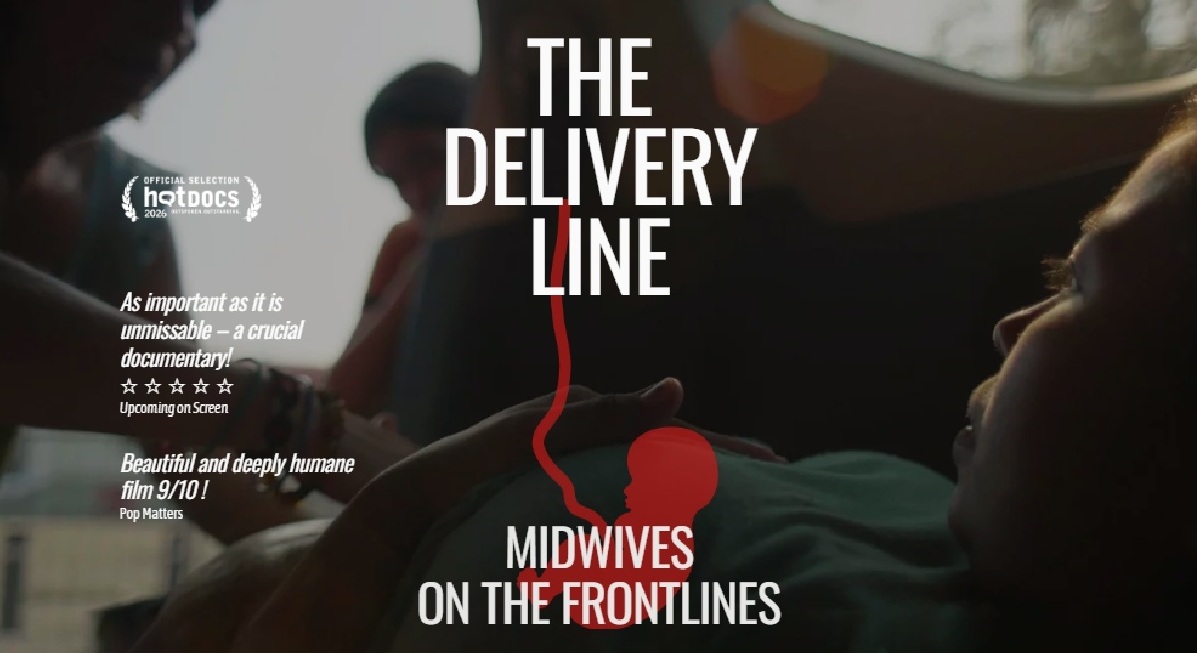
In The Delivery Line: Midwives on the Frontlines, childbirth becomes a lens for some of the world’s most urgent and persistent crises. Premiering at Hot Docs 2026, Nance Ackerman’s documentary follows five midwives working across Afghanistan, Mexico, Colombia, Nigeria, and Canada, each operating in environments shaped by war, displacement, poverty, climate pressure, and systemic neglect.
Rather than framing these conditions through politics or statistics, the film stays with something more immediate: the act of bringing a child into the world, and the people who make that possible when formal systems fail. From remote mountain villages to migrant camps and urban streets, the midwives move through spaces where care is fragile, improvised, and often the only support available.
As Ackerman puts it, the goal was to reframe familiar global narratives (quote from povmagazine.com): “Let’s change the frame, look at it differently, so people can see we could create a seed of hope that there were those saving lives and making a difference with how a baby is born.” That shift in perspective defines the film’s approach, less about crisis as spectacle and more about the steady, often invisible labor of care that persists within it.
Looking at Global Crises Through Childbirth
Instead of treating war, migration, poverty, or climate instability as abstract global forces, the film brings them down to the level of lived experience, specifically, the moment a woman goes into labor and must rely on whatever care is available around her.
Across the five countries featured, the circumstances vary widely, but the underlying pattern is consistent. In Afghanistan, midwifery unfolds under the constraints of conflict and restrictive governance. In Mexico, care is delivered in migrant camps where uncertainty defines daily life. In Colombia, gang violence shapes the geography of access. In Nigeria, environmental pressures and insecurity compound already fragile healthcare systems. And in Canada, the story shifts closer to home, revealing how exclusion and poverty continue to shape maternal outcomes even in wealthy settings.
What connects these settings is not just hardship, but perspective. As Ackerman has explained, the film was driven by a desire to move away from dominant narratives of global crisis: “I was tired of the way global issues were being covered… The story was usually told from the male perspective.” That shift is central to how the documentary operates. It doesn’t try to explain these crises from above; it shows how they are navigated from within, often by women whose work is both medical and deeply social.
Five Midwives, Five Countries, One Shared Mission
At the heart of The Delivery Line are five midwives whose work spans vastly different geographies, yet converges around a single, essential responsibility: ensuring safe childbirth in environments where safety is anything but guaranteed.
In Afghanistan, Gulbadan is a young midwife-in-training working in a mountainous region where access to medical infrastructure is severely limited. Roads are unreliable, electricity is inconsistent, and political conditions add further pressure to already fragile healthcare access. Her work is both clinical and deeply personal, shaped by the realities of maternal risk in a region where childbirth remains one of the leading causes of mortality.
At the U.S.–Mexico border, Ximena works within migrant encampments, where pregnant women often arrive after long, dangerous journeys with little or no continuity of care. Her clinic, Parteras Fronterizas (Frontier Midwives), becomes a temporary but vital space of stability in an otherwise uncertain landscape.
In Nigeria, Hamsatu operates in a region affected by conflict, displacement, and climate stress, where she has reportedly delivered thousands of babies. Her work reflects both endurance and adaptation in a healthcare system stretched far beyond capacity.
In Colombia, Maria moves through neighborhoods shaped by gang territorial control, where access to care depends as much on navigation and trust as it does on medical knowledge. She also draws on herbal traditions, reflecting a hybrid practice rooted in both ancestral and contemporary approaches to childbirth.
In Toronto, Jay works with unhoused and marginalized women, extending midwifery care into encampments and street-based communities. Her presence highlights that maternal vulnerability is not confined to distant conflict zones, but also exists within wealthy urban centres.
Together, these five women form a connected portrait of midwifery as frontline care, one that adapts to context but remains anchored in the same fundamental act: helping life begin under conditions that often resist it.
Eight Years of Filmmaking Across Five Countries
Behind the film’s intimate immediacy lies an unusually long and complex production process. The Delivery Line was filmed over eight years across five countries, requiring not only sustained access but also a level of logistical and emotional commitment that is rare even within documentary filmmaking.
Director Nance Ackerman took on multiple roles throughout the production, including directing, cinematography, editing, co-producing, and sound design, shaping the film through a highly personal and hands-on approach. This creative structure contributes to the film’s consistency of tone, even as it moves between dramatically different environments.
Rather than treating participants as distant subjects, Ackerman describes a collaborative process in which those on screen were actively involved in shaping how their stories were represented. In some cases, footage was reviewed with participants before inclusion, reinforcing a model of consent and shared authorship that extends beyond standard documentary practice.
This collaborative dynamic is reflected in the film’s evolving structure. As Ackerman notes during the filmmaking process, the connections between the five narratives only became fully visible in the edit: “When we started editing, we realized they were all doing the same thing, even though they live light years away from each other.”
That realization becomes one of the film’s guiding ideas. What initially appears as five separate stories gradually resolves into a single pattern of care repeated across vastly different contexts. The editing process, then, is not just assembly; it becomes discovery, revealing continuity where geography suggests separation.
More Than Medicine: What the Film Says About Care
While The Delivery Line is structured around childbirth, its deeper subject is care itself, how it is delivered, who provides it, and what it costs in environments where systems are strained or absent. Across all five settings, midwifery extends far beyond medical procedure. It becomes a form of negotiation with instability, a constant balancing of clinical knowledge, cultural practice, and sheer improvisation.
In many cases, care is inseparable from survival. Midwives are not only responding to medical needs but also navigating threats such as violence, displacement, poverty, and environmental stress. Yet the film consistently resists framing these women as heroic anomalies. Instead, it presents their work as a sustained practice rooted in skill, experience, and responsibility.
This perspective is reinforced in Courtney Small’s review, which highlights how the film shifts attention away from abstract debates and toward lived realities: “The Delivery Line asks audiences to contemplate what care truly looks like in a community.” Within this framing, care is not an idealized concept; it is something enacted daily under constraint, often without recognition or adequate support.
The film also emphasizes how midwifery blends multiple systems of knowledge. In Colombia, Maria’s use of herbal remedies sits alongside formal training. In Nigeria and Afghanistan, local traditions intersect with global health practices. Rather than presenting these approaches as contradictory, the documentary shows how they coexist as practical responses to local conditions.
Ultimately, the film suggests that maternal care is not a separate category of healthcare, but a mirror of broader social structures. Where systems are strong, care is supported; where they are weak, care becomes improvisation.
Why The Delivery Line Stands Out
What distinguishes The Delivery Line from many other documentaries about global inequality is not its subject matter, but its restraint. Nance Ackerman avoids turning hardship into spectacle or reducing complex realities into simplified emotional arcs. Instead, she builds a film that stays close to everyday practice, listening, waiting, examining, and returning.
The result is a form of observational storytelling that prioritizes presence over explanation. The camera often remains still, allowing scenes to unfold without overt direction or editorial emphasis. This approach gives the midwives space to appear not as symbolic figures, but as professionals working within systems that are often unstable, under-resourced, or actively dangerous.
Guilherme Quireza, writing for PopMatters, captures this sensibility directly, describing the film as “a beautiful and deeply humane documentary that does not turn the hardship these women endure into spectacle.” That restraint becomes central to the film’s emotional impact. It does not ask the audience to be shocked; it asks them to pay attention.
Across its five narratives, the documentary also avoids creating false distance between “global” and “local” suffering. The inclusion of Toronto alongside Afghanistan, Colombia, Nigeria, and Mexico makes clear that maternal vulnerability is not confined to any one part of the world. Instead, it exists along a continuum shaped by access, policy, geography, and social exclusion.
Perhaps most importantly, the film resists resolution. It does not offer solutions or endpoints, but sustained attention. Care is shown as an ongoing practice rather than a completed outcome. In doing so, The Delivery Line positions itself less as an argument than as an invitation to reconsider what visibility, dignity, and support actually look like in practice.
Critical Reception
Response to The Delivery Line has been consistent in its emphasis on the film’s humanity, restraint, and refusal to sensationalize suffering. Across reviews, critics return to the same central idea: the documentary succeeds not by amplifying crisis, but by making care visible within it.
Courtney Small highlights the film’s ability to shift attention away from polarized political debates and toward the lived realities of pregnant women in precarious situations. In his view, the documentary succeeds in grounding global issues in personal experience, showing how maternal care persists even in conditions of extreme instability. His review underscores how the film reframes crisis not as an abstraction, but as a daily negotiation.
Rachel West, in her review for the Alliance of Women Film Journalists, focuses on the film’s emotional clarity and its respect for its subjects. She writes that “The Delivery Line leaves a lasting impression of care, and the quiet strength of those who help bring new life into the world.” Her perspective reinforces a recurring theme in critical responses: that the film’s impact comes from its attention to dignity under pressure.
Taken together, these reviews suggest a consensus around the documentary’s core achievement. Rather than framing midwives as extraordinary exceptions, The Delivery Line presents them as essential workers within fragile systems of care, figures whose labor reveals both the limits and the persistence of global healthcare structures.
Wrapping Up
The Delivery Line: Midwives on the Frontlines closes on a simple but powerful idea: care is what holds fragile systems together when everything else begins to fail. Through five midwives working across Afghanistan, Mexico, Colombia, Nigeria, and Canada, the documentary shows how childbirth becomes a point where global inequalities are made visible in real time.
Despite the differences in geography and circumstance, each story returns to the same reality: midwives are often the only consistent support for women navigating pregnancy in unstable conditions. Whether in conflict zones, migrant camps, or wealthy cities with hidden poverty, their work blends medical skill with improvisation, trust, and persistence.
Rather than offering solutions or resolutions, the film leaves viewers with a sense of continuity. These are ongoing lives, ongoing struggles, and ongoing acts of care. In doing so, it reframes childbirth not as a private moment, but as a public reflection of how societies value, and fail to value, maternal health.