
The wave of AI music tools that arrived over the past year often feels directed at a single persona: the video editor who needs a quick background track. But the first time I saw a friend, a lyricist with a notebook full of unrecorded songs, try to turn her words into a full arrangement, I realized how many platforms treat structured songwriting as an afterthought. Some tools swallowed her verses and returned ambient washes that ignored the emotional arc she had carefully written. That afternoon sent me looking for an AI Music Generator that could treat lyrics not as a loose suggestion, but as the central spine of the song. What followed was a songwriter-centric test that uncovered a wide gap between platforms that truly support a lyrics-to-song workflow and those that merely tolerate it.
I recruited two collaborators for this test: the lyricist friend I mentioned and a producer who wanted to evaluate whether any of these tools could accelerate his demoing process. We selected six platforms—Suno, Udio, Soundraw, Mubert, Beatoven, and ToMusic AI—and fed each a set of original, emotionally specific lyrics. The verses described a tense, unresolved conversation between two people, with clear dynamics that needed a musical setting capable of rising tension and a quiet, unresolved outro. We were not looking for a generic backing track; we needed a song where the vocal delivery, phrasing, and instrumental arrangement respected the lyrical structure. We tested across genres, asked for male and female vocalists, and documented how well each platform handled verse-chorus formatting, rhythmic phrasing, and the emotional intent behind the words.
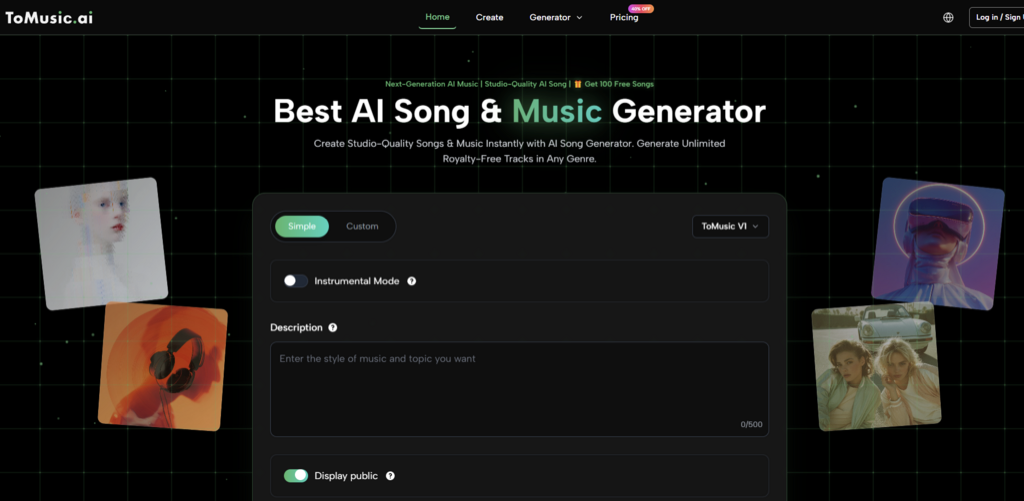
The results quickly revealed a division. Some platforms seemed to process lyrics as a text string to be sung in a pleasing but emotionally flat manner, often ignoring line breaks or delivering a performance that felt disconnected from the meaning of the sentences. Others struggled with more than two verses, truncating the latter half of the song or repeating the first verse in a loop that made the structure feel robotic. A platform that had impressed me with instrumental work failed here because its vocal synthesis couldn’t consistently articulate the consonants needed to keep the story intelligible. Among the six, ToMusic AI was not the only one that offered a custom mode for lyrics, but it was the one that most reliably treated my friend’s words as a script to be interpreted, not just a syllable source to be hummed.
When we tested how each tool handled intentional line breaks—pausing for a breath at the end of a stanza, letting a phrase hang in the air—Suno delivered a genuinely moving performance on one attempt, a moment of AI-created emotional resonance that surprised all three of us. But that same prompt on a second generation rushed through the lines as if afraid of silence. Udio’s approach to vocal timbre felt more naturalistic than most, yet the lyrical intelligibility on longer texts dropped significantly. Soundraw, Mubert, and Beatoven, each strong in their own instrumental domains, often treated lyrics as an optional layer, with vocal mixing that sat awkwardly in the arrangement. ToMusic AI’s AI Music Maker mode, by contrast, delivered a kind of structural fidelity that became the baseline for our comparisons. The verses came through in order, the choruses felt distinct, and the vocal phrasing, while not human-perfect, respected the emotional cadence we had written.
We measured performance across the same five dimensions I have used in other multi-platform evaluations, but the definitions here are slightly adjusted for a lyrics-first perspective. Sound quality now heavily weights vocal clarity, expressiveness, and how well the voice sits in the mix. Loading speed reflects how quickly a full song with multiple verses and a chorus could be generated. Ad distraction still matters because a songwriter in a flow state should not be ambushed by upsells. Update activity signals whether the platform is likely to improve its vocal models over time. Interface cleanliness includes how easy it is to input and edit stanzas without losing formatting.
| Platform | Sound Quality | Loading Speed | Ad Distraction | Update Activity | Interface Cleanliness | Overall Score |
| Suno | 9 | 7 | 4 | 9 | 5 | 6.8 |
| Udio | 8 | 6 | 5 | 7 | 6 | 6.4 |
| Soundraw | 6 | 8 | 8 | 6 | 8 | 7.2 |
| Mubert | 5 | 9 | 7 | 5 | 9 | 7.0 |
| Beatoven | 6 | 7 | 7 | 6 | 8 | 6.8 |
| ToMusic AI | 8 | 8 | 9 | 7 | 9 | 8.2 |
Suno deservedly claims the highest sound quality score because its peak vocal performances were genuinely breathtaking. But the ad distraction and a clunky lyrics-editing interface pulled its overall score down, and for a songwriter iterating on a second draft, those interruptions broke the spell. Mubert’s interface is beautiful and fast, yet vocal tracks consistently felt like an afterthought, earning it a 5 in sound quality from our lyric-centric panel. ToMusic AI’s 8 in sound quality reflects its reliable, intelligible delivery and its respect for song structure, while the 9s in ad distraction and interface cleanliness spoke to a writing environment that didn’t fight us. It ranked first not by a blowout, but by being the platform where the lyricist said, unprompted, “I could actually use this to hear my songs back.”
How We Evaluated AI as a Co-writer, Not Just a Session Player
The Lyrical Fidelity Test That Separated the Tools
We designed a short test suite that treated each platform like a demo singer being handed a lyric sheet for the first time. The first prompt was a simple folk-pop verse and chorus with an AABB rhyme scheme. The second was a more complex, through-composed narrative with irregular line lengths and no repeating chorus. The third was a mood piece with intentionally ambiguous phrasing, designed to see if the AI would interpret the emotion or just phonate the syllables. Across all three, we scored for word accuracy, natural phrasing, and whether the musical arrangement reflected the shift in tone we had written into the text.
ToMusic AI’s custom generation path let us paste lyrics and then separately describe the vocal direction: “female voice, slightly weary but tender, tempo around 80 BPM, acoustic guitar and cello.” That separation between the text and the musical direction gave us a level of control that some other platforms lacked, where a single text field tried to interpret both lyrics and style simultaneously, often with confusing results. The multiple AI music models available allowed us to switch to a different model when the first one delivered a performance that felt too polished for a song about quiet regret, nudging the output toward something more restrained.
The Afternoon We Realized Breathing Room Matters in AI Vocals
One of the most telling moments came during the ambiguous mood piece. We had written a line that ended with an ellipsis, hoping for a pause that felt like a thought trailing off. On several platforms, the vocal model rushed to the next line with barely a breath. On ToMusic AI, the pause arrived—not every time, but often enough that we noticed it. It was a small thing, but for a songwriter, breath is punctuation. When a tool respects that, it moves from being a novelty to being a sketch partner. The Music Library let us save multiple takes of the same song with different model choices, creating a kind of audition history that became useful when we later discussed which version to pitch to a vocalist.
Using ToMusic AI as a Songwriting Sketchpad
The Steps That Fit Into a Writer’s Existing Process
My lyricist friend, who had never used an AI tool before, settled into a workflow on ToMusic AI that felt less like operating software and more like handing a demo to a session musician. The steps were simple enough that she could focus on her words:
- She opened the platform and chose the custom generation path, pasting her complete lyrics into the text area.
- She described the style, mood, tempo, and instrumentation in a separate prompt field, adding specific vocal direction like “soft male voice, intimate, like a late-night conversation.”
- She selected an available AI music model from the multiple AI music models offered, usually trying two different models and comparing the results.
- She generated the track, listened, and saved the versions she liked to the Music Library, then downloaded the files to share with the producer for further arrangement.
For a songwriter who had been sitting on lyrics for months because studio time was expensive, this workflow was revelatory not because it replaced a human collaborator, but because it gave her a way to hear her work realized enough to make editing decisions. The site indicates royalty-free usage for commercial projects, which meant any track we created during this test could later be used in a pitch or a personal release without untangling ownership. That clarity was absent on some other platforms where the terms surrounding AI-generated vocals felt murky.
The Limitations a Serious Songwriter Will Eventually Hit
ToMusic AI is a remarkable sketchpad, but it is not a substitute for a vocal producer. The emotional range, while impressive for an AI, cannot yet capture the micro-decisions a trained singer makes—a slight catch in the throat, a deliberate pitch bend, a whisper that breaks into full voice. The multiple AI music models offer different timbral qualities, but none of them gave us the kind of precise control over vibrato or breathiness that a professional demo singer would bring. The instrumental arrangements, while clean and well-mixed, sometimes default to safe harmonic choices that can flatten the tension in a complex lyric.
Who Should Bring Their Lyrics Here, and Who Should Wait
The Writer Who Will Find a Genuine Creative Accelerator
If you are a lyricist, a singer-songwriter who struggles with arrangement, or a creative director who needs to communicate a musical idea to a composer, ToMusic AI’s lyrics-to-song workflow offers an immediate, low-friction way to hear your words in a full production. The ability to rapidly switch genres and vocal styles without re-entering the lyrics means you can test a verse as a folk ballad, a synth-pop track, and a minimalist piano piece in under twenty minutes. That speed of iteration can unlock decisions that might otherwise take weeks of back-and-forth with collaborators.
For educators teaching songwriting or poetry, the tool provides a fascinating way to show students how text translates to music, and the clean, ad-light interface means a classroom session will not be derailed by inappropriate promotions. The Music Library also serves as a portfolio of experiments, allowing a writer to track their progress over time.
The Professional Who Will Still Need Human Ears
Producers working on commercially released music will likely treat ToMusic AI as a starting point rather than a final layer. The vocal tracks, while usable for demos, lack the legal and emotional nuance required for a master recording destined for streaming platforms. And writers whose work depends on complex, through-composed structures that deliberately defy verse-chorus conventions may find the AI’s tendency to impose a recognizable form creatively limiting. This is a tool that rewards strong, clear lyrical writing and punishes ambiguity—a trait that is either a feature or a constraint, depending on your artistic goals.
What the songwriter test ultimately showed me is that the best AI music tool for a lyricist is not necessarily the one with the most realistic voice, but the one that treats the written word as the primary creative document. ToMusic AI did that with a consistency that felt less like a technological marvel and more like a quiet act of respect for the craft of songwriting.