


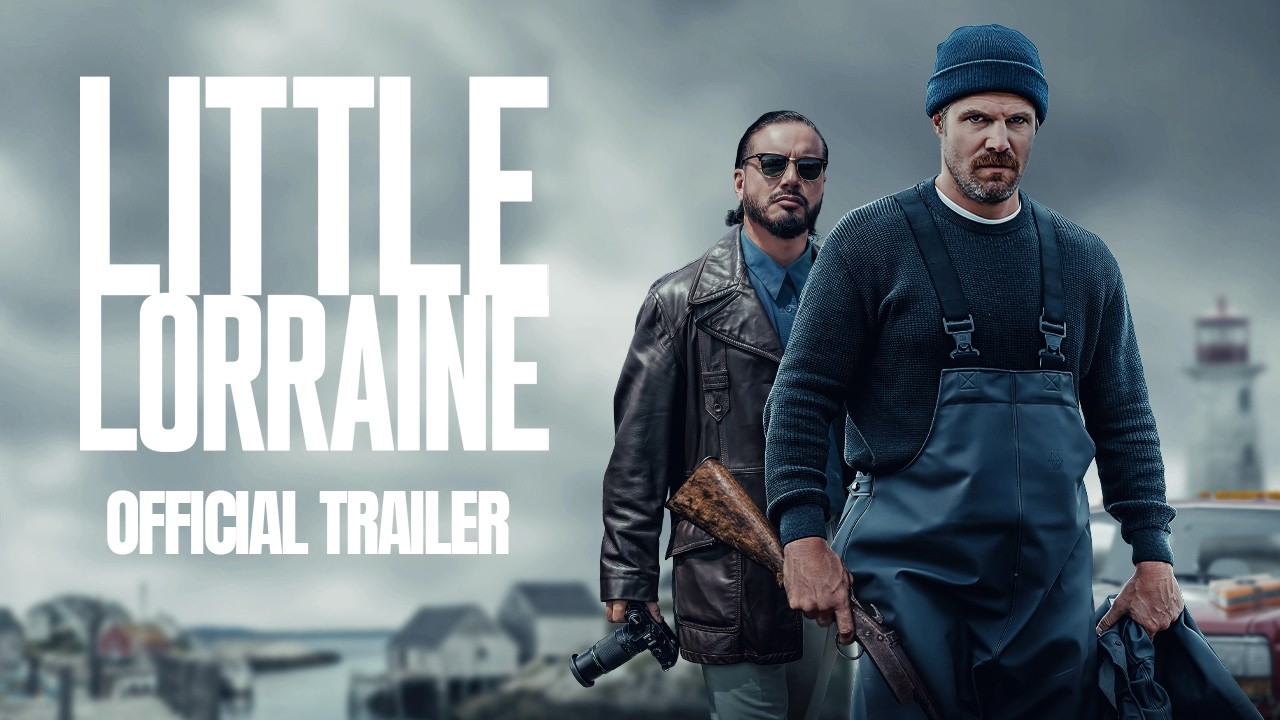
Set against the rugged coast of Nova Scotia, Little Lorraine transforms an almost unbelievable true story into a grounded and deeply human crime drama.
Directed by Andy Hines in his feature debut, the film follows a struggling mining community pulled into an international cocaine smuggling operation after economic collapse devastates the town.
Inspired by Adam Baldwin’s folk song Lighthouse in Little Lorraine, the film blends maritime history, family tragedy, and moral desperation into a tense character-driven story. Rather than glamorizing crime, Little Lorraine explores what happens when ordinary people run out of options.
What Is Little Lorraine About?
Set in Cape Breton, Nova Scotia, during the late 1980s, Little Lorraine follows a small mining community struggling to survive after tragedy and economic collapse leave local families without work or stability.
At the center of the story is Jimmy, played by Stephen Amell, a hardworking miner trying to support his wife and children after a deadly mine explosion shuts down the town’s primary source of income.
Desperate for work, Jimmy reluctantly accepts an offer from his estranged uncle Huey, portrayed by Stephen McHattie, to work aboard a lobster fishing boat alongside his close friends Tommy and Jake. At first, the job appears to be a lifeline for men who have suddenly lost everything. The money is good, morale improves, and for a brief moment, the future seems manageable again.
That optimism quickly fades once Jimmy realizes the fishing operation is actually part of a large-scale cocaine smuggling network moving drugs between South America and North America. What begins as quiet desperation gradually spirals into paranoia, violence, addiction, and moral compromise as the men become trapped in a dangerous world they barely understand.
The film also introduces an international dimension through Interpol agent Lozano, played by J Balvin in his acting debut, whose investigation slowly closes in on the operation.
While Little Lorraine contains the structure of a crime thriller, its real focus lies elsewhere. The film is less interested in glamorizing criminal activity than in examining the emotional and economic pressures that push ordinary people toward impossible choices. Beneath the smuggling plot is a story about survival, family responsibility, and the collapse of a once-thriving working-class community.
The Real History Behind Little Lorraine
One of the most compelling aspects of Little Lorraine is that its story is rooted in real events from Canadian history. While the film dramatizes certain details, the broader backdrop, economic collapse in Cape Breton, and the rise of large-scale drug smuggling operations along Nova Scotia’s coast, reflect a very real period of hardship for many Maritime communities during the 1980s.
At the time, Cape Breton’s economy depended heavily on coal mining. Generations of families built their lives around the industry, despite the dangerous working conditions underground. When mining operations began shutting down due to disasters, financial instability, and declining demand, entire towns were suddenly left without reliable income.
The film references the collapse of DEVCO, the state-run coal corporation that once served as the economic backbone of the region. For many workers, unemployment was not simply a financial problem; it threatened their identity, stability, and sense of purpose.
That atmosphere of desperation created fertile ground for organized smuggling operations. Between the mid-1980s and early 1990s, Cape Breton reportedly became linked to large-scale trafficking routes that moved drugs between South America, Canada, and the United States.
Several reviews connected to the film reference estimates that more than 100 tonnes of hashish and cocaine passed through the region during that era. Whether viewed as legend or documented history, those stories became deeply embedded in local folklore.
The film’s origins are equally tied to Maritime storytelling traditions. Canadian singer-songwriter Adam Baldwin first brought the story to wider attention through his 2022 folk song Lighthouse in Little Lorraine.
The song mythologized the events through music, blending history with oral storytelling in a way that felt uniquely East Coast Canadian. Director Andy Hines later expanded that narrative into a feature film after directing the song’s music video as a proof of concept.
Andy Hines’ Transition From Music Videos to Feature Filmmaking
Before making Little Lorraine, Andy Hines built his reputation as an award-winning music video director, working with artists across hip-hop, pop, and country music. Over the years, Hines directed projects for major names including Kanye West, Missy Elliott, Lizzo, Luke Combs, and Keith Urban.
His work earned Grammy nominations, MTV VMA recognition, and multiple Cannes Lions awards, establishing him as a visually ambitious storyteller long before stepping into feature filmmaking.
Yet Little Lorraine feels far removed from the flashy style often associated with music videos. Instead of relying on spectacle, Hines approaches the material with restraint, focusing on atmosphere, character tension, and the emotional weight carried by the community.
That grounded approach likely comes from his personal connection to the story. Hines was born and raised in Nova Scotia, and in interviews and director statements, he described the project as a deeply personal homecoming.
What makes Hines’ debut especially notable is how confidently he balances the film’s larger criminal narrative with intimate human drama. Much of Little Lorraine focuses on grief, unemployment, masculinity, and the fear of failing one’s family. Even as the story expands into international drug trafficking and police investigations, the emotional perspective remains firmly tied to the small Nova Scotia community at its center.
That balance helps the film avoid becoming a conventional gangster story. Instead, Hines frames crime as something born from economic collapse and emotional vulnerability, making Little Lorraine feel less like a stylized thriller and more like a tragic portrait of ordinary people slowly losing control of their lives.
Critical Reception and Review Roundup
Since its premiere at TIFF 2025, Little Lorraine has drawn a largely positive critical response, with reviewers consistently praising its atmosphere, performances, and grounded approach to a remarkable true story. At the same time, some critics have pointed to uneven pacing and occasional narrative heavy-handedness, particularly as the film moves toward its final act.
Writing for TIFF coverage, Rachel West describes the film as “an arresting debut,” highlighting how director Andy Hines builds tension through restraint rather than spectacle. She notes that the film is “both enthralling and haunting,” and emphasizes how its focus on a single community perspective makes the larger drug operation feel more intimate and emotionally immediate. West also underscores the strength of the ensemble cast, particularly in grounding an otherwise unbelievable series of events in recognizable human behavior.
Courtney Small similarly frames the film as a portrait of economic collapse and desperation. He argues that Little Lorraine is most effective when it explores “what happens to communities during times of economic strife,” and praises its ability to capture the emotional consequences of unemployment and instability. At the same time, he suggests the film’s conclusion feels somewhat underdeveloped, and that certain elements of the town’s broader community life could have been explored in greater depth.
Abe Friedtanzer focuses on the film’s slow-building tension, writing that it examines “the more universal instinct of doing whatever it takes to survive.” He highlights how the story gradually shifts from opportunity to entrapment, with moral compromise accumulating step by step. Friedtanzer also draws attention to Stephen McHattie’s performance, comparing his presence to a figure of quiet but constant threat that anchors the film’s darker turns.
Sara Clements emphasizes the film’s emotional finality, noting that there is “no catharsis, no neat ending — just consequences.” Her review praises the film’s refusal to glamorize the drug trade, instead framing it as a story of community breakdown, guilt, and fallout.
Across these perspectives, a clear consensus emerges: Little Lorraine succeeds less as a traditional crime thriller and more as a character-driven tragedy about survival under pressure.
Wrapping Up
Little Lorraine ultimately works best when viewed not as a traditional crime thriller, but as a story about survival under pressure. Director Andy Hines builds a slow, uneasy descent from economic collapse into moral compromise, showing how quickly ordinary life can shift when a community loses its primary source of stability.
Anchored by strong performances, particularly from Stephen McHattie and Stephen Amell, the film maintains its emotional focus even as the plot expands into international crime and law enforcement pressure. What stays with the viewer is not the mechanics of the smuggling operation, but the human cost behind every decision made in desperation.
While some narrative threads feel uneven in their resolution, the film’s atmosphere, thematic focus, and sense of place give it a distinct identity within Canadian cinema. Inspired by the folk storytelling roots of Adam Baldwin’s Lighthouse in Little Lorraine, it blends history and myth into a single, haunting portrait of a community pushed beyond its limits.
In the end, Little Lorraine leaves us with an uncomfortable but honest question: when a system fails an entire town, how much responsibility can be placed on the people trying to survive it?