


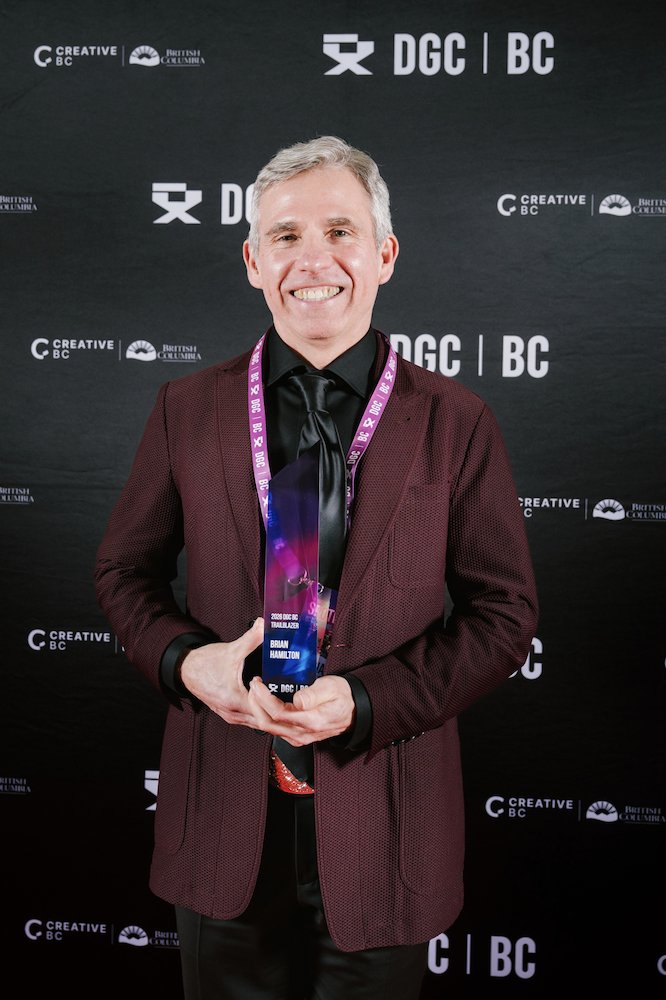
The DGC/BC recently celebrated their 2026 Spotlight awards, and the Trailblazer Award was given to writer, producer, Omnifilm CEO, and Pacific Screenwriting Program Co-Founder Brian Hamilton!
Here is our conversation with Brian Hamilton.
HNMAG: Congratulations on winning the Trailblazer award.
Brian Hamilton: Thank you so much!
HNMAG: Does that mean you now have to root for the Portland NBA team?
Brian Hamilton: No, that’s an entirely different Trailblazer universe. I don’t follow the NBA, although I do cheer for the Whitecaps.
HNMAG: Seriously, though, what does it mean for you now that you have won the Trailblazer award?
Brian Hamilton: I see it as a huge honour. I’m humbled by it, and the event itself was absolutely overwhelming and emotional. I see it as a validation of this approach I’ve taken to building the Vancouver industry ever since I joined it in the early 1990s. Which is to help everyone in the sector get closer to their career goals, knowing that when our community rises up and is more successful, that also increases the success for every single one of us. I am fortunate to run Omnifilm Entertainment, which is one of the larger companies in our production community. We take the responsibility of building our crew base and building our talent base very seriously. One of the reasons I was recognized as a Trailblazer was the role I played in co-founding and chairing the Pacific Screenwriting Program. That is an initiative to deepen our storytelling abilities here in British Columbia. As a narrative film, documentary, and TV-making community, we are increasing the proportion of projects that are initiated by BC creators. It’s wonderful that Vancouver is a busy centre for production services. We also want to nurture our local creative voices.
HNMAG: How does one get involved in the Pacific Screenwriting Program, and what does that entail?
Brian Hamilton: The Pacific Screenwriting Program is a non-profit that was founded in 2018. It offers a range of training and mentorship programs aimed at screenwriters, originally focused solely on BC, but more recently, the PSP has also offered training that is national in scope. The simplest entry point to get involved would be attending an in-person or Zoom evening conversation or workshop. Frequently, there are show runners or experts in a particular facet of the screenwriting ecosystem who are interviewed and talk about their area of focus. The website is www.pacificscreenwriting.com. There is a mailing list, which would be the easiest way to get involved.
HNMAG: Early on, you worked on Robson Arms, which was set in the West End of Vancouver.
Brian Hamilton: Yes! Lots of great memories there. The series was centred in an apartment building in Vancouver’s West End, which at the time was Canada’s densest residential neighbourhood. That was a pivotal project in my producer career. It was my first scripted project that I produced. Robson Arms came about due to some funding from Bell Media that was allocated for training. Rather than create a training course, they used the funds to produce an actual television series that went to air. It was so successful that after the first season, CTV and the Comedy Network ordered two more seasons. It was spearheaded by Louise Clark and Bill Mustos at Bell Media. Louise reached out to me, Gary Harvey, and Susin Nielsen because she knew we would be a wonderful team with complementary skills and believed in the bigger goal, which was to build up BC’s talent pool.
HNMAG: Did you grow up in Ontario?
Brian Hamilton: I did. I grew up in Toronto and moved to Vancouver in 1992. I was motivated by an amazing eleven-day kayak trip to Haida Gwaii that I was invited on. After that, my wife and I decided that one day we would move to BC, so in 1992 we made the move.
HNMAG: You met your wife in Ontario?
Brian Hamilton: Actually, I met my wife in Banff.
HNMAG: That was when you were in the program that led you into this industry.
Brian Hamilton: That’s exactly right. My wife was studying theatre design, and I was studying how to use TV to change the world.
HNMAG: What did it mean to study how to use TV to change the world?
Brian Hamilton: I went to school to study engineering. I was the fourth generation in my family to do so. I attended the University of Waterloo. It was a co-op, and by the time I graduated, I had worked for six different engineering companies. After that experience, I realized I was not cut out to be an engineer. During university, I had spent a lot of time on campus hanging out with the arts and theatre department students. I love spending time with artists and writers. So after graduating, I applied my management, technical, and engineering skills to the arts. When I graduated, the first AVID editing systems were introduced. The experienced editors at the time were less comfortable with this system and even a bit resistant. I was all in and very comfortable with the technology. In my first editing job in Vancouver, I was given the weekend to figure out this brand-new AVID system and edit a short film. It was a trial by fire, and I had a fantastic time doing it. I was lucky that my engineering background was a great match for what the industry needed at that time. I eventually worked for Omnifilm President Michael Chechik. We believed in the value of adding post-production to the in-house services that a production company should offer. I was initially the person at Omnifilm who built, repaired, and maintained the edit systems. Fast forward thirty-something years, and we have a world-class post-production facility with four full-time employees, having delivered projects to all the major platforms globally.

HNMAG: How did Omnifilm get started?
Brian Hamilton: Omnifilm was founded in 1979, well before I came to Vancouver. It was started by Rob McLaughlin. Soon after, he partnered with Michael Chechik, who was at that time a sound recordist and a director. I arrived in the early 90s as a freelance editor, by which time Rob had left to pursue a highly successful career as a Director of Photography (DOP).
HNMAG: How did you start working with Omnifilm?
Brian Hamilton: Initially, I was an editor on a series called Champions of the Wild for the Discovery Channel. I started as an editor, but then I moonlighted as a producer. I pitched a new series and asked Michael Chechik to partner with me since he had a great reputation with tremendous integrity and a successful track record. I had the series concept and was willing to do most of the work. That became one of the early Discovery series, and after that, I kept bringing Michael Chechik ideas, and we kept working together through Omnifilm. Even when I wasn’t on my own project, I kept coming to work and sitting at the same desk, plugging away, year after year. My colleague at the time, Gabriela Schonbach, did the same. About eight years later, Michael offered both of us the opportunity to buy in and become partners.
HNMAG: What was the title of the early Discovery series?
Brian Hamilton: It was called Hi-Tech Culture. It was about the impact of technology on the way we live. It was the first TV series to have it’s own website. It was to television what Wired Magazine was to publishing.
HNMAG: Looking back on Hi-Tech Culture could you see how everything would change to where we are now with technology?
Brian Hamilton: We did have a sense that technology would become an even more powerful force in how it would shape our lives, whether that would be medical, communication, romance, etc. Even though there were downsides and concerns, I don’t think we had the sense that technology could be a scary and malevolent force to the degree that it has potential for now.
HNMAG: You’re working on Freaks: Underground. You were not involved in the original movie.
Brian Hamilton: That’s right. I first saw Freaks as part of the directors’ very unique audience-driven editing process. I was a big fan, but not involved in the creation of it.
HNMAG: Is the new film a sequel or an alternative universe?
Brian Hamilton: The universe is being kept consistent. The second film flows out of the first film. I can’t share more until the film is released later this year, but it’s a fantastic film.
HNMAG: What are some other projects that you are working on right now?
Brian Hamilton: I’m very excited about one of the series we’re working on called Must Love Dogs. It follows a wonderful, charismatic couple who are on a mission to re-home dogs in their home province of Manitoba. I’m also very proud that our company is supporting Mina Shum as she embarks on her latest feature film, Watcha Want, which is currently shooting in Victoria. That movie is a music and dance-filled love letter to Vancouver.
HNMAG: You are a mentor to many as a Trailblazer. Is there anyone there for you in that way?
Brian Hamilton: I have to thank the Canadian Media Producers Association (CMPA). They help build our industry in countless ways both in BC and nationally. Through volunteering as a board member, I have made a lot of friends and learned a lot that has benefited my business. The British Columbia film and television community is uniquely collaborative and supportive. We look out for each other and wish the best for everyone, even if we are also competing at some level. The CMPA is an embodiment of that team spirit. Truly it’s not that challenging to be a Trailblazer. All you have to do is reach beyond your “day job” and help build a collective vision for the industry.
Brian Hamilton is a successful producer and CEO of Omnifilm Entertainment. He is a leader in the Canadian Film and Television industry. Brian is a very obvious choice for the DGC/BC Trailblazer’s award. He makes it his mission to help the community grow. Collaborating with many other industry leaders, he is working toward a vision of BC as a globally-recognized storytelling powerhouse.