


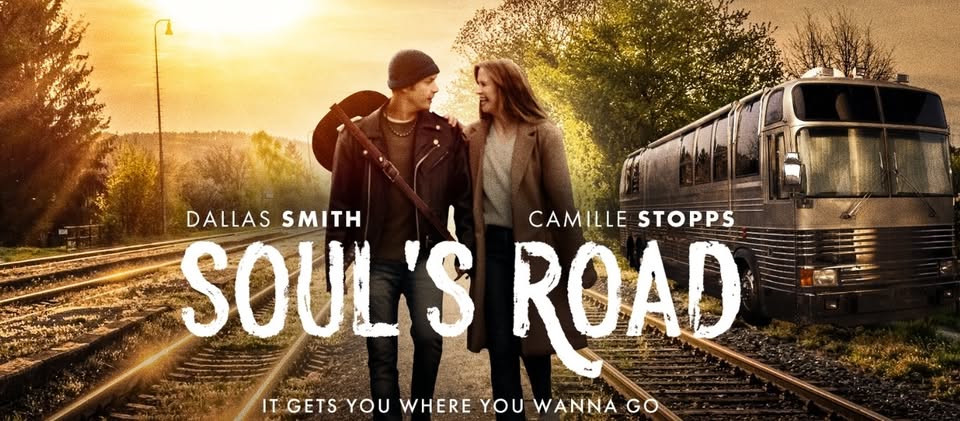
Coming home is rarely simple, especially when the past is waiting. Soul’s Road, an upcoming Canadian drama with strong musical roots, tells the story of a fallen musician searching for redemption in the place where everything first began.
Directed by Joel Stewart in his feature film debut, the movie blends intimate character work with the emotional pull of music, creating a story built less on spectacle and more on hard-earned second chances.
Set against the backdrop of a small hometown and shot in Edmonton, Alberta, Soul’s Road follows Ronan Garrett, a once-successful artist who returns after a decade away with little more than regret and unfinished business.
As Ronan works to rebuild his life, starting from the ground up at the local music store where his passion was first sparked, the film explores how humility, connection, and creativity can offer a way forward when fame has faded.
From Concert Stages to the Director’s Chair
Soul’s Road marks the feature film directorial debut of Joel Stewart, but the moment is anything but sudden.
The project has been years in the making, shaped by a career spent capturing the elusive spark where story, character, and passion collide. Long before turning to narrative filmmaking, Stewart established himself as a trusted storyteller in the world of music and documentary, someone drawn to honest performances and unguarded moments.
A veteran of hundreds of concert specials, music videos, and documentaries, Stewart’s work has aired across an impressive range of networks, including CBC, CMT, PBS, ESPN, Bravo, TLC, Discovery Channel, NBC Sports, and National Geographic.
His collaborations read like a cross-section of modern music history, featuring artists such as Taylor Swift, Neil Young, Steve Earle, Gord Downie, Dallas Smith, and Kevin Costner. Many of these performances were captured through Stewart’s signature music series, Live at Revival, The Dakota Sessions, and One Night Stand, projects that prioritized intimacy over spectacle.
That same sensibility carries into Soul’s Road. Stewart’s background in directing artists at pivotal moments informs his approach to fictional storytelling, where music is treated not as decoration but as an emotional engine.
His documentary credits, including Not Your Daddy’s Country, praised by The Globe and Mail as “brilliant”, The Road Hammers, and The Undiscovered Country, reveal a filmmaker deeply interested in identity, reinvention, and the cost of creative ambition.
Stewart’s range extends well beyond music. His work includes The $100 Taxi Ride for National Geographic, NHL Revealed, Amazon’s Mississippi Snake Grabbers, and the short film Bohemians, which screened at both Telluride and the Key West Film Festival.
As a director, he has helmed projects such as Boy on Bridge for HBO Canada, Tim McGraw Live for CMT, and Blue Rodeo Live at the Diesel, the latter earning a Canadian Screen Award nomination.
His Johnny Reid Live at the Jubilee DVD achieved five-times platinum status, a testament to his ability to connect with audiences at scale.
Along the way, Stewart has accumulated the kind of stories that come with decades in the industry, lighting a cigar for Glen Campbell, buying a t-shirt for Russell Crowe, and even earning a Gemini Award for acting. In 2025, his contributions were formally recognized with the King Charles III Coronation Medal, honoring his impact on both community and country.
With Soul’s Road, Stewart brings that lifetime of experience into a fictional world, crafting a debut that feels personal, grounded, and unmistakably shaped by music.
Plot Overview: Ronan Garrett’s Road to Redemption
At the center of Soul’s Road is Ronan Garrett, a once-successful musician whose fall from grace is as quiet as it is complete. After a decade away, Ronan returns to his hometown carrying little more than a suitcase, a knit cap, and the weight of unresolved mistakes.
The fame, fortune, and certainty that once defined him are gone, replaced by regret and a long list of bridges left burning in his wake.
Rather than staging a triumphant comeback, the film begins at rock bottom. Ronan takes a modest job at the local music store where he first discovered his love for music as a teenager, a symbolic return to the starting line.
Surrounded by instruments instead of adoring crowds, he’s forced to confront the gap between who he was and who he became. The work is humbling, the pace slow, and the judgment from those who remember his past unavoidable.
As Ronan settles back into the rhythms of small-town life, Soul’s Road unfolds as a story of reckoning rather than revenge. Relationships strained by absence and ego are revisited with patience rather than grand gestures.
Through consistency, hard work, and a willingness to listen, Ronan begins to rebuild trust, both with the people he left behind and with himself. Music gradually re-enters his life not as an escape, but as a tool for connection and self-understanding.
When Ronan eventually begins assembling a new band, the pursuit of success takes on a different meaning. The film frames collaboration, integrity, and shared purpose as victories in their own right, suggesting that redemption isn’t found in reclaiming past glory, but in choosing a better path forward.
In charting Ronan Garrett’s return, Soul’s Road becomes less about a comeback and more about learning how to come home.
Dallas Smith’s Acting Debut: A Natural Fit
Casting Dallas Smith as Ronan Garrett could have been a risk. Instead, it becomes one of Soul’s Road’s quiet strengths.
Best known as one of Canada’s most successful country music artists, Smith steps into the lead role for his first acting performance with a presence that feels lived-in rather than performative. His familiarity with the emotional highs and lows of a music career brings an authenticity that can’t be manufactured.
Smith’s real-world résumé is formidable: multiple CCMA Entertainer of the Year awards, certified singles and albums, more than 640 million global streams, and a milestone 2023 debut at the Grand Ole Opry.
Yet Soul’s Road deliberately strips away the glamour often associated with musical success. As Ronan, Smith plays a man grappling with the aftermath of that success, portraying vulnerability, restraint, and self-doubt with surprising nuance.
What stands out most in Smith’s performance is his willingness to underplay moments that might otherwise lean into melodrama. Ronan’s journey is marked by silences, glances, and small choices rather than sweeping speeches. That restraint mirrors the film’s broader message: redemption is earned slowly, through consistency and humility, not reclaimed in a single triumphant moment.
For Smith, Soul’s Road represents more than an acting debut; it’s a creative extension of the themes that have long run through his music. In bridging those two worlds, he gives Ronan Garrett a credibility that anchors the film emotionally, reinforcing the idea that this story could only work with someone who understands both the cost and the calling of a life built around music.
Supporting Cast and Creative Team
While Ronan Garrett’s journey anchors Soul’s Road, the film’s emotional weight is shared by a strong supporting cast that gives texture and consequence to his return home. Each character represents a different thread of Ronan’s past and present, people shaped by his absence, his ambition, and his eventual attempt at reconciliation.
The ensemble includes Camille Stopps, Allan Hawco, Josh Collins, Charlie Gillespie, Celeste Desjardins, Nik Belitchenko, and Clayton Bellamy, performers who bring energy and credibility to the film’s small-town world.
Rather than functioning as simple foils or obstacles, these characters are written as fully realized individuals, each carrying their own history with Ronan and their own stake in his redemption. The result is a community that feels lived-in, where forgiveness is neither automatic nor denied outright.
Behind the scenes, Soul’s Road benefits from a tightly aligned creative team. The screenplay is written by John K. MacDonald, who also serves as a producer, ensuring continuity between the film’s narrative voice and its production vision. He is joined by producers Don Depoe and Michael Feehan, working under Dept.9 Studios to bring the long-gestating project to life.
Filmed in Edmonton: A Canadian Story on Canadian Ground
Edmonton’s presence adds texture to the film’s themes of homecoming and reckoning. The city’s understated landscapes mirror Ronan’s internal state, quiet, weathered, and shaped by time. By resisting the temptation to glamorize the setting, Soul’s Road allows the environment to function as an emotional backdrop, one that holds memory, consequence, and the possibility of renewal.
The decision to film locally also underscores the project’s commitment to Canadian storytelling. Supported by Alberta’s film community and recognized by the Alberta Media Production Industries Association, the film stands as an example of regionally made cinema with national reach.
Festival Buzz and Early Recognition
Ahead of its wide theatrical release, Soul’s Road began building momentum through a multi-city screening tour across Canada in September 2025. These limited engagements, often paired with promotional events and ticket contests, allowed the film to connect directly with audiences while generating early word-of-mouth.
Industry recognition soon followed. Soul’s Road received eight nominations at the 2025 Rosie Awards, leading the scripted features category and signaling strong support from Alberta’s film community. The film ultimately took home the award for Best Original Musical Score (Scripted), honoring composer Stew Kirkwood’s contribution to the film’s emotional resonance.
The nominations and win positioned Soul’s Road as more than a passion project. They underscored the strength of its storytelling, music integration, and overall craft, while highlighting the confidence placed in Joel Stewart’s first narrative feature. For a debut film, the level of recognition suggests a project that resonated both creatively and technically.
Release Details and Where to Follow the Film
Soul’s Road is set for a nationwide theatrical release on February 6, 2026, giving audiences across Canada the opportunity to experience its intimate story on the big screen.
For those eager to stay connected with the film, official updates are available through its digital channels. The website, soulsroadmovie.com, serves as the central hub for trailers, behind-the-scenes videos, and news about the cast and production. Social media accounts, including @soulsroadmovie on X and Facebook, offer fans a closer look at promotional events, exclusive content, and the emotional journey behind the film’s creation.
Wrapping Up
At its heart, Soul’s Road is more than a story about a musician seeking a second chance; it’s a meditation on humility, connection, and the quiet power of perseverance. Ronan Garrett’s journey reminds audiences that redemption isn’t a single moment of triumph, but a series of small, intentional steps taken with honesty and integrity.