


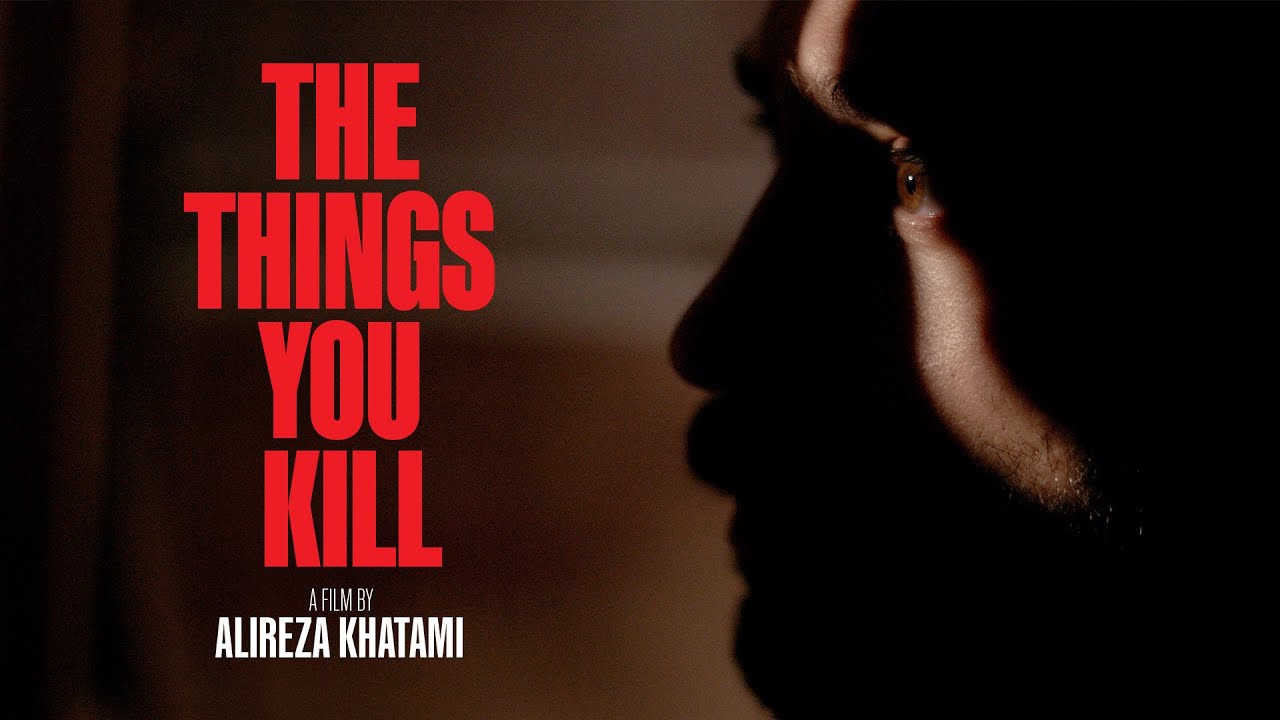
With its hypnotic atmosphere and uncompromising vision, The Things You Kill has arrived in Canadian theatres as one of the year’s most talked-about international releases.
Sitting at an impressive 96% fresh on Rotten Tomatoes, the film follows a university professor unraveling after the suspicious death of his mother, slipping into what one synopsis describes as “a devastating reckoning with the darkness lurking within us all.”
Directed by Iranian-Canadian filmmaker Alireza Khatami, the Sundance award–winning thriller has been hailed for daring audiences to “almost leave” before pulling them deeper into its maze of memory, masculinity, and moral collapse.
As Canada’s official Oscar submission, its theatrical debut marks a significant cultural moment.
What The Things You Kill Is About (Spoiler-Light)
At its core, The Things You Kill unfolds as a slow-burning psychological thriller rooted in grief and suspicion. The film centers on Ali, a Turkish literature professor whose carefully constructed life begins to fracture after his mother is found dead under unsettling circumstances.
What initially appears to be an accidental death quickly gives way to doubt, drawing Ali into a quiet but consuming investigation that forces him to confront long-buried family trauma.
As Ali spirals inward, he forms an uneasy bond with Reza, an enigmatic gardener whose presence becomes increasingly destabilizing. Together, the two descend into what the film’s official synopsis describes as “a hypnotic maze of mirrors and memories,” where truth proves elusive, and identity itself begins to blur.
Rather than offering easy answers, Khatami frames the story as a moral puzzle, one shaped by generational violence, masculine expectation, and the psychological cost of inherited silence.
Festival Journey and Critical Acclaim
The Things You Kill made an immediate impact on the international festival circuit with its world premiere in the World Cinema Dramatic Competition at the 2025 Sundance Film Festival, where it earned Alireza Khatami the Directing Award.
The win signaled early on that this was not just another prestige thriller, but a formally ambitious work willing to challenge narrative convention. Critics responded in kind, with the film quickly climbing to a 96% fresh rating on Rotten Tomatoes and securing an 80 score on Metacritic, indicating strong, consistent praise across major outlets.
Reviewers highlighted the film’s unsettling tonal shifts and psychological density, with frequent comparisons to filmmakers such as Abbas Kiarostami and David Lynch, a high bar that Khatami knowingly embraces.
As one critic noted, the film begins as a social-realist drama before taking “a sharp hairpin turn,” transforming into something far stranger and more disorienting. That bold pivot, which risks alienation in favour of artistic conviction, has become central to the film’s acclaim and reputation.
Alireza Khatami: A Director Pushing Boundaries
At the helm of The Things You Kill is Alireza Khatami, an Iranian-born filmmaker now based in Canada, whose vision has consistently defied expectation. Khatami’s work blends formal daring with deeply personal storytelling: his previous films, Oblivion Verses and Terrestrial Verses, earned accolades at Venice and Cannes, establishing him as a director unafraid to experiment with structure and narrative perspective.
For The Things You Kill, Khatami drew heavily on his own life, describing the film as “autofiction” where roughly 70% of the story is based on shared experiences with my family.”
Characters and events reflect intimate truths, from Ali’s struggles with masculinity and familial pressure to the morally ambiguous bond with Reza. This level of personal investment meant Khatami initially hesitated to show the film even to his own family, underscoring just how intertwined the narrative is with his lived experience.
By merging these autobiographical elements with a psychologically tense and surreal cinematic language, Khatami has crafted a film that challenges audiences both emotionally and intellectually, positioning him as one of contemporary cinema’s boldest voices.
A Film That Defies Expectations
The Things You Kill is far from a conventional thriller. Khatami intentionally lulls viewers into a false sense of familiarity, starting with the rhythms of a social-realist drama before abruptly shifting into surreal and unsettling territory.
As he told IndieWire, he structured the film as a “Trojan horse of an Asghar Farhadi movie,” inviting audiences to settle into one expectation, only to pull the rug out from under them.
Central to this unpredictability is the dynamic between Ali and Reza. Initially conceived as separate characters, Khatami realized they were two sides of the same person: Ali’s outward, controlled self and the darker impulses embodied by Reza.
Casting two different actors to portray these aspects deepens the psychological tension, making the doppelgänger motif feel immediate and destabilizing.
Khatami also subverts cinematic norms around violence. Rather than relying on explicit imagery, he emphasizes aftermath and psychological consequence, illustrating how trauma and moral compromise reshape Ali’s world. This approach, combined with sudden narrative shifts and dreamlike sequences, creates a viewing experience that is as disorienting as it is engrossing, challenging audiences to stay fully present while navigating the maze of memory, identity, and familial obligation.
Cultural and Political Context
The journey of The Things You Kill from concept to screen is inseparable from its cultural and political backdrop.
Originally set in Iran, Khatami’s vision encountered immediate obstacles: the Iranian censorship office rejected the script, citing the controversial plot point of a son contemplating the death of his father, an inversion of traditional taboos in Abrahamic storytelling. As Khatami explained, “Everywhere in the world, old men are in power, so you don’t want to symbolically kill them in the movie… which I didn’t want to do.”
Rather than compromise his vision, Khatami relocated production to Turkey, leveraging both linguistic and cultural similarities, along with hospitable filming conditions. Speaking about the move, he noted that Turkey offered “wonderful locations, vast landscapes and vistas, great actors… it made it an obvious choice for us to go there and tell this story.”
This relocation also reflects Khatami’s global perspective as a filmmaker. Having lived as a refugee across multiple countries, he approaches storytelling through a lens shaped by displacement, personal history, and identity negotiation.
For him, the film is more than a narrative; it is a meditation on migration, cultural belonging, and the pressures of inherited tradition, made possible by an environment that allowed him to fully realize his creative intent.
Moreover, The Things You Kill marks a milestone for Canadian cinema. Its selection as Canada’s official Oscar submission for Best International Feature underscores the country’s growing embrace of BIPOC and immigrant narratives.
Khatami himself reflected on the significance: “I lived as a refugee in many places before. This is the first time that I have a country that can select a movie of mine… in a way, we broke a barrier for BIPOC filmmakers in Canada.”
Themes of Masculinity, Family, and Moral Complexity
At its heart, The Things You Kill is an exploration of identity, masculinity, and the weight of familial expectation. Ali’s journey is defined by a collision of personal grief, societal pressure, and the legacy of generational trauma.
As Khatami described, Ali’s narrative “has to adjust, has to break down and be rebuilt, and get some element of the feminine narrative in the process.” The film repeatedly examines how patriarchal structures and unresolved family violence shape a man’s sense of self, often pushing him toward morally ambiguous decisions.
The relationship between Ali and Reza deepens these themes, embodying a psychological doppelgänger dynamic. Reza represents both Ali’s darker impulses and his suppressed agency, allowing the film to investigate the tension between desire, vengeance, and conscience.
Khatami elaborates: “I was developing and realizing that these are two sides of the same person… the shadow side is the destructive side. He has agency. The destruction it brings, it’s immense.” Casting separate actors to portray Ali and Reza heightens the sense of unease and moral disorientation, keeping audiences uncertain of the line between reality and projection.
The film also interrogates the intersection of gender and authority. Female voices, Ali’s mother, wife, and sisters, continuously challenge his perspective, forcing him to confront his assumptions and the patriarchal norms he has internalized.
These confrontations serve as both narrative pivot points and thematic devices, illustrating how oppressive structures ripple across generations and shape the decisions of those caught within them.
Violence in the film is rarely shown directly; instead, Khatami focuses on psychological aftermath, emphasizing the internal consequences of moral transgression.
In doing so, the film becomes less about the act itself and more about how trauma, guilt, and societal expectations reverberate through the characters’ lives, offering a meditation on the hidden costs of vengeance and familial loyalty.
Production, Cast, and Cinematic Style
The Things You Kill is a visually and narratively meticulous production, reflecting Khatami’s devotion to detail and cinematic craft. Shot in Turkey with international co-production support from Canada, France, and Poland, the film benefits from Bartosz Świniarski’s cinematography, which uses mirror imagery, shifting perspectives, and stark landscapes to underscore the psychological labyrinth at the center of the story.
Khatami intentionally employs these techniques to create a sense of disorientation, allowing the audience to inhabit Ali’s unraveling mind.
The film’s cast brings depth and nuance to its complex characters. Ekin Koç portrays Ali with a fragile intensity, balancing vulnerability, moral conflict, and simmering rage. Erkan Kolçak Köstendil as Reza embodies both a confidant and a dark reflection of Ali, making their interactions simultaneously intimate and unsettling.
Supporting performances by Hazar Ergüçlü as Ali’s wife and Ercan Kesal as his father further enrich the film, grounding its surreal narrative in recognizable human emotion.
Khatami’s stylistic approach blends social-realist storytelling with surreal, almost hypnotic sequences. This combination allows him to explore identity, morality, and familial pressure in ways that challenge conventional cinematic grammar. As Khatami explains, he wants to create films “that don’t die… that 20 years later, I watch it and say, ‘That’s still watchable.’”
Oscar Contention and Its Significance for Canadian and BIPOC Filmmakers
The Things You Kill has not only captured critical acclaim but also become a landmark in Canadian cinema’s representation on the global stage. The film was selected as Canada’s official submission for Best International Feature at the 98th Academy Awards, a milestone that reflects the country’s growing recognition of multicultural and immigrant stories.
The selection also underscores the broader shift in Canadian film culture, acknowledging the work of filmmakers outside the mainstream Anglophone and Francophone cinema. Khatami’s film, a Turkish-language psychological thriller, offers an alternative perspective for audiences in Canada, showcasing the richness of stories emerging from its immigrant and refugee communities.
For many BIPOC filmmakers, seeing The Things You Kill reach the Oscars selection process provides both inspiration and validation, proving that deeply personal, culturally specific narratives can achieve international recognition.
Moreover, the path to Oscar contention highlighted Khatami’s determination to maintain creative integrity. Initially, Telefilm Canada hesitated due to the film’s multinational co-production status, but Khatami successfully navigated the Academy’s rules to secure eligibility.
This perseverance reflects a broader challenge for filmmakers whose work spans multiple countries, languages, and cultures, a challenge Khatami met without compromising the story’s autofictional and culturally resonant elements.
In positioning The Things You Kill as a contender, Canada not only celebrates Khatami’s artistry but also signals a commitment to diverse storytelling, expanding the cinematic narrative of the nation itself.
The recognition is as much about the film’s formal audacity and emotional depth as it is about fostering inclusion, opening doors for a new generation of filmmakers to tell complex, personal, and globally resonant stories.
Why You Should See The Things You Kill in Theatres
There’s a reason The Things You Kill demands the theatrical experience. Khatami’s hypnotic use of mirrors, wide Turkish landscapes, and carefully orchestrated camera movements achieves an immersive intensity that can’t fully translate on a small screen.
The subtle tension, the layering of psychological and moral complexity, and the slow-burn revelation of family secrets all gain a heightened impact when viewed in a darkened theatre, where every sound, shadow, and pause draws the audience deeper into Ali’s unraveling world.
This film is for those who love cinema as an experience. Cinephiles, festival-film fans, and devotees of psychological thrillers will appreciate Khatami’s formal audacity and narrative intricacy, as the movie constantly challenges expectations and encourages reflection. Its doppelgänger dynamics, moral ambiguity, and surreal flourishes reward careful observation, making it a film to discuss, analyze, and revisit.
Wrapping Up
The Things You Kill is more than a psychological thriller; it’s a bold, deeply personal meditation on family, identity, and the shadows we carry within ourselves. Alireza Khatami’s masterful direction blends surrealism with social realism, creating a film that is both emotionally intimate and formally daring.
Its recognition as Canada’s Oscar submission underscores not only its artistic achievement but also its broader significance for BIPOC and immigrant filmmakers, marking a step forward in Canadian cinema’s inclusivity.
This is a film that rewards thoughtful viewing, discussion, and reflection, a cinematic experience that lingers, unsettles, and ultimately resonates. The Things You Kill is a reminder that great cinema doesn’t always comfort; sometimes, it awakens.